
Why This Decision Matters More in Texas Than Most Places
Texas puts a roof through a little of everything: long stretches of intense summer heat, sudden hailstorms, high wind events, and UV exposure that doesn't let up for months at a time. Whatever material goes on top of a home in the DFW Metroplex has to survive all of that without breaking down early, which is exactly why the asphalt versus metal question comes up so often for homeowners planning a replacement.
Both materials are common across North Texas roofs, and both can be installed correctly or poorly. The real differences show up in how each one ages over 10, 20, or 30 years, how it sounds and feels to live under, and what it costs to own over that time. This guide walks through those differences so you can match the material to your house and your plans for it, not just the sticker price.
What Actually Makes These Two Materials Behave Differently
The core difference comes down to how each material handles heat, impact, and water over time. Asphalt shingles are layered mats of fiberglass or felt coated in asphalt and mineral granules, built to shed water and flex slightly with temperature swings. Metal panels, whether standing seam or screw-down, are solid sheets that expand and contract as a unit and rely on seams and fasteners rather than overlapping layers to keep water out.
Heat and UV Exposure
Asphalt shingles absorb heat and slowly lose granules and oils to UV exposure over the years, which is part of why they have a finite service life in a hot climate. Lighter-colored shingles perform somewhat better against heat than dark ones, but all asphalt products trend the same direction over time.
Metal panels reflect a larger share of solar radiation, especially with reflective coatings, and don't degrade from UV exposure the way asphalt does. That's part of why metal tends to outlast shingles by a wide margin in the same Texas sun, though the panels themselves can still fade or chalk slightly over decades.
Impact and Wind Behavior
Asphalt shingles, especially impact-resistant Class 4 products, are designed to absorb hail strikes without puncturing, though they can still bruise or lose granules in a hard hit. Standard three-tab shingles are more vulnerable to wind lift in gusty conditions than architectural shingles are.
Metal panels generally resist hail punctures well, particularly thicker gauge products, though cosmetic denting is possible depending on hail size and panel type. When installed with proper fastening patterns, metal roofing also tends to perform strongly in high wind, which matters across open parts of North Texas.
| Factor | Asphalt Shingles | Metal Roofing | |
|---|---|---|---|
| Typical service life | Roughly 18-22 years in a hot climate, by industry norms | Often 40-50+ years depending on the system | Varies by product grade and install quality |
| Upfront cost | Lower material and install cost generally | Higher upfront investment generally | Cost gap narrows over the life of the roof |
| Heat reflectivity | Absorbs more heat, especially dark colors | Reflects more solar heat overall | Can affect attic temperature and cooling load |
| Noise in rain | Quiet by default | Quiet when installed over solid decking | Noise myths usually come from old agricultural panels |
The Parts of the System Most Homeowners Don't See
Whichever material you choose, the roofing system underneath does a lot of the work. Underlayment, flashing around chimneys and vents, and attic ventilation all affect how long either material performs well. A premium metal panel over poor ventilation can still trap heat and moisture problems, and a mid-grade shingle over a well-ventilated, properly flashed deck can outperform expectations.
Fastener type matters too. Metal systems depend on exposed or concealed fasteners that need periodic checking over decades, while shingle systems rely on nail patterns and sealant strips that set shortly after install. Neither system is maintenance-free, they just ask for different kinds of attention over the years.
Step-by-Step: How to Decide Between the Two for Your Home
There's no single right answer, but walking through these questions in order tends to point most homeowners toward a clear choice.
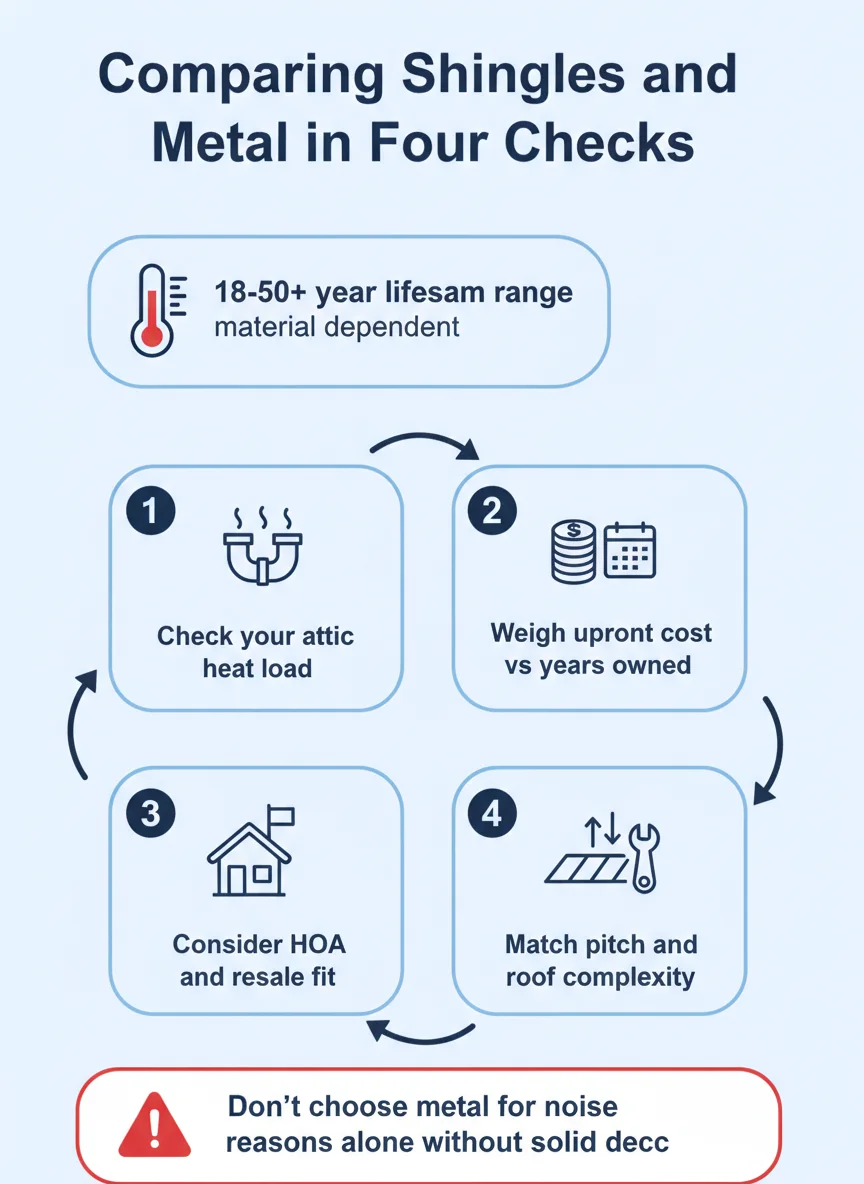
- Set your time horizon: Decide roughly how many years you plan to own the home, since metal's higher upfront cost pays off more clearly over a longer hold.
- Check your roof pitch: Steep, complex rooflines can add install complexity and cost for either material, but especially for metal panel layouts.
- Review HOA rules: Some Texas neighborhoods restrict metal roofing or require specific colors and profiles, so check before you fall in love with a style.
- Think about attic heat: If summer cooling costs are a pain point, metal's reflectivity may matter more to you than it would to a neighbor.
- Get an inspection: A roof inspection tells you the real condition of your decking and ventilation before you commit to either material.
- Compare real quotes: Get roof replacement quotes for both materials side by side so you're comparing real numbers for your specific roof, not averages.
What You'll Actually Notice Living Under Each One
On paper the comparison is about lifespan and cost, but day to day the differences are smaller than people expect.
Living With Asphalt Shingles
Most Texas homeowners already live under asphalt shingles and barely think about the roof between inspections. They blend into most neighborhood aesthetics, come in a wide range of colors and styles, and are straightforward to repair if a section gets damaged, since matching shingles is usually easy to source.
The tradeoff shows up later in ownership, as granule loss, curling, or algae streaking becomes visible with age, particularly on roofs facing intense afternoon sun. None of that happens overnight, but it's part of why shingle roofs eventually need full replacement rather than indefinite patching.
Living With Metal Roofing
Homeowners who switch to metal often mention a cooler attic in peak summer and the long stretch of years before they expect to think about roofing again. Standing seam profiles in particular have become a popular look on both traditional and modern Texas homes, not just barns and outbuildings anymore.
The adjustment is mostly financial. Metal costs more to install, and if a panel is damaged, color matching an older run can be harder than swapping a shingle. Most owners find the tradeoff is worth it specifically because they don't expect to repeat the project for decades.
What a Homeowner Can Decide Alone vs What Needs a Pro
Picking a color, a shingle style, or a metal panel profile is something a homeowner can research and choose on their own, since it's mostly a matter of taste and matching the home's style. Budget range and how long you plan to stay in the house are also decisions only you can make.
Everything involving the structure itself belongs with a licensed roofer. That includes confirming your decking can support the chosen material, checking that attic ventilation is adequate for either system, and evaluating flashing details around chimneys, skylights, and valleys. Texas building code also affects what's allowed for certain installs, and a professional will know what applies in your city.
If you're torn between the two, a roofer can also walk the property with you and point out which features of your specific home, like pitch, sun exposure, and neighboring tree cover, might tip the decision one way or the other. That's usually more useful than a generic rule of thumb.
Making the Call for Your Roof
Both asphalt shingles and metal roofing hold up well in Texas when they're installed correctly, so the choice really comes down to how long you plan to own the home, your budget horizon, and what you want from the roof day to day. Neither is the wrong answer, they just serve different timelines and different priorities.
If you want a clearer read on which material makes sense for your specific roof, Renovacore Builders LLC can walk the property with you and lay out the real tradeoffs before you decide.
Frequently asked questions
Is metal roofing worth it in Texas?
Metal roofing can be worth it for homeowners planning to stay put for a long time, since it typically lasts far longer than asphalt and handles Texas heat and hail reasonably well. It costs more upfront, so the payoff depends on how many years you'll own the house.
Is metal roofing louder than shingles in the rain?
Not when it's installed correctly over solid decking and underlayment, which is standard practice. The 'tin roof' noise most people picture comes from old agricultural panels installed directly over open framing, not a properly built residential metal roof.
Do asphalt shingles or metal roofs handle Texas heat better?
Metal reflects more solar heat than most asphalt shingles, which can mean a slightly cooler attic in summer. Asphalt shingles still perform fine in Texas heat, they just absorb more heat than metal does over the course of a hot afternoon.
Does metal roofing increase home resale value?
In many markets it's viewed as a durable, low-maintenance upgrade, which can be a selling point, but the effect on resale price varies by neighborhood and buyer expectations. Asphalt remains the most common roof type in most Texas subdivisions, so it rarely hurts resale either.
Can you install metal roofing over existing shingles?
It depends on the specific metal system, your roof's current condition, and local building code allowances, so this is a conversation to have with a roofer who can look at the structure. In many cases a full tear-off is recommended to check the decking underneath.