
Why Attic Airflow Matters More Than Most Homeowners Realize
In the Dallas-Fort Worth Metroplex, roofs deal with long stretches of intense summer heat followed by sudden cold snaps, and an attic sits right in the middle of both. Most people think about what's hitting the shingles from above, sun, wind, the occasional hailstorm, but a huge share of roof damage actually starts from underneath, inside an attic that isn't moving air the way it should.
A properly ventilated attic stays closer to outdoor temperature year round. A poorly ventilated one can climb well past the air temperature outside on a summer afternoon, and in winter it can trap enough moisture to soak the underside of the decking. Either way, the roofing system above it pays the price over time, which is why ventilation deserves the same attention as the shingles themselves.
How Does Attic Ventilation Actually Work?
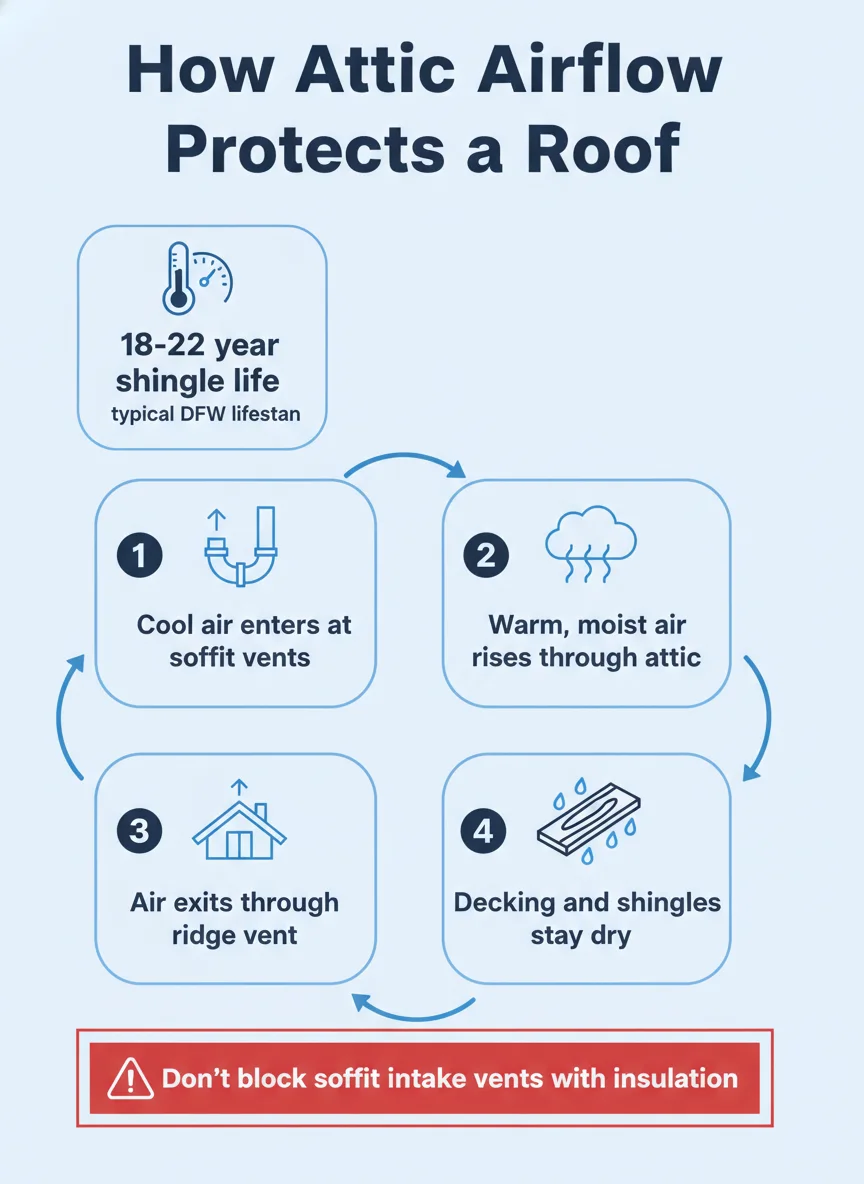
Attic ventilation works on a simple principle: cooler air enters low and warm air exits high, creating continuous airflow that keeps temperature and moisture from building up. It's a passive system in most homes, relying on pressure differences rather than fans, which means it only works if every part of the path is open and unobstructed.
Intake: Where Air Enters the Attic
Intake typically happens at the soffit, the underside of the roof overhang, through small perforated vents or continuous vent strips. This is the cool air supply for the whole system, and if it's blocked by insulation, paint, or debris, the rest of the ventilation system has nothing to pull from.
Some older homes rely on gable vents near the roofline instead of soffit vents, which can work but tend to create less even airflow across the whole attic. Knowing which type your home has helps explain why one section of the attic might run hotter than another.
Exhaust: Where Air Leaves the Attic
Exhaust vents sit near the peak of the roof, most commonly a ridge vent that runs the length of the roofline, though some homes use individual box vents or a powered attic fan instead. This is where the warm, moist air that's risen through the attic finally escapes.
For the system to work, intake and exhaust need to be roughly balanced. Too much exhaust and too little intake can actually pull conditioned air out of the living space below, which drives up energy bills instead of solving the problem.
| Condition | Well-Ventilated Attic | Poorly-Ventilated Attic |
|---|---|---|
| Summer heat | Attic stays closer to outdoor air temp | Attic temperature climbs well above outdoor air |
| Winter moisture | Moist air exits before it condenses | Moisture collects on decking and framing |
| Shingle condition | Even aging across the roof surface | Premature curling or blistering from below |
| Energy bills | Cooling system works less hard | Cooling system runs longer in summer |
What's Actually Part of an Attic Ventilation System
An attic ventilation system is made up of several parts working together: soffit vents for intake, a ridge vent or box vents for exhaust, baffles that keep insulation from blocking the soffit openings, and sometimes a powered fan for additional exhaust in attics that need extra help. None of these parts do much good on their own.
The decking itself, the layer of sheathing the shingles are fastened to, is what suffers most when ventilation fails. Chronic moisture exposure can cause it to soften, delaminate, or sag over time, which is a far more expensive problem to fix than adding a few vents would have been.
Step-by-Step: How to Check Your Attic's Ventilation
You don't need special tools to get a basic read on your attic's condition. A flashlight, a dry day, and a few minutes are usually enough to spot the early warning signs.
- Pick a hot afternoon: Check the attic on a warm, sunny day when ventilation problems are easiest to notice through heat buildup.
- Feel the temperature: If the attic feels dramatically hotter than the outside air, that's a sign exhaust isn't keeping up with heat buildup.
- Look at the soffits from inside: Check whether you can see daylight or feel airflow at the soffit vents, and confirm insulation isn't piled against them.
- Check the decking: Look for dark staining, soft spots, or any frost in cold weather, all of which point to trapped moisture.
- Inspect the shingles from inside: Look for nail points pushing through the decking with rust or moisture around them, a common sign of condensation.
- Note any smells: A musty or damp odor usually means moisture has been sitting in the attic longer than it should.
- Call for a second opinion: If anything looks off, a roof inspection can confirm whether the ventilation system needs adjustment.
What You'll Typically Find When Ventilation Has Been a Problem
Signs on the Roof Surface
From the outside, poor attic ventilation often shows up as shingles that curl or blister unevenly, sometimes concentrated in certain sections of the roof rather than spread uniformly. This pattern is a clue the damage is coming from below the shingle rather than from sun exposure alone.
In some cases the decking itself has softened enough that it's noticeable when walked on during a roof repair or replacement, well before the shingles above show obvious wear. That's usually the point where a homeowner learns ventilation was part of the story all along.
Signs Inside the Attic
Inside the attic, the clearest signs are visible moisture, whether that's frost on nail tips in winter, dark water staining on the decking, or active mold growth on framing members. Insulation that's wet or compacted near the eaves is another strong indicator that intake vents have been blocked.
None of these signs mean the roof needs to be replaced immediately, but they do mean the attic environment has been working against the roofing system for some time, and that's worth addressing before it compounds.
What a Homeowner Can Check vs. What Needs a Roofer
A homeowner can absolutely do the basic visual check described above: looking for daylight at the soffits, feeling attic temperature, and scanning for obvious staining or odor. These don't require climbing on the roof or touching any ventilation hardware.
Adding, moving, or resizing vents is a different matter. Cutting a ridge vent opening, adding soffit vents, or rebalancing an exhaust system affects the structural integrity of the roof deck and needs to be done by someone who understands how much net free ventilation area the attic actually requires for its size.
If decking has already softened or shingles are showing damage tied to ventilation, that's squarely a job for a licensed roofer. Replacing compromised decking, correcting vent balance, and reinstalling shingles correctly over the repair all need to happen together, not piecemeal.
Keeping a DFW Attic Working for the Roof, Not Against It
Attic ventilation isn't an exciting topic, but it quietly decides how long a roof actually lasts compared to how long it's rated to last. In a region that swings between brutal summer heat and sharp winter cold snaps, an attic that can't move air is working against the roof every single day, not just during extreme weather.
A quick look during routine maintenance, paired with attention to the early warning signs covered here, catches most ventilation problems long before they turn into a decking or shingle replacement. Renovacore Builders LLC checks attic ventilation as part of our inspection process across the DFW Metroplex, including Dallas and Fort Worth, and can also walk you through what's covered in our related guide on seasonal roof checks.
Frequently asked questions
What does attic ventilation actually do for a roof?
Attic ventilation moves air continuously through the space under the deck, pulling in cooler air at the eaves and pushing warm, moist air out near the peak. This keeps the decking dry and keeps attic temperatures from building to extremes that stress shingles from underneath. Without it, heat and moisture have nowhere to go.
How do I know if my attic has a ventilation problem?
Common signs include frost or moisture on the underside of the decking in cold weather, curling or blistering shingles from the top down, unusually high cooling bills in summer, and a noticeably hot attic even on mild days. A musty smell or visible mold on rafters is also a red flag. If you notice any of these, it's worth having the attic looked at.
Can too much insulation cause ventilation problems?
Yes, insulation pushed too far into the eaves can physically block the soffit vents, cutting off the intake air a ventilation system depends on. Even a well-designed ridge and soffit system fails if intake is blocked. A baffle (sometimes called a rafter vent) is typically installed to hold insulation back from the vent opening.
Does every house need ridge and soffit vents?
Most homes benefit from a balanced system with intake low (soffit) and exhaust high (ridge or roof vents), but the right setup depends on the attic's shape, the roof's design, and how the home was originally built. Some older homes use gable vents or powered fans instead. A [roof inspection](/services/roof-inspections-maintenance) can confirm what your attic currently has and whether it's balanced.
Can poor attic ventilation shorten the life of a roof?
Yes, sustained heat and trapped moisture can degrade shingles, warp decking, and in cold snaps contribute to ice damming at the eaves, all of which shorten the usable life of the roofing system. It's one of the more overlooked causes of early roof failure because the damage starts from underneath, not from the weather hitting the shingles directly.