
A Denial Letter Isn't Always the End of the Story
Homeowners across the DFW Metroplex deal with this more than they'd like: a storm rolls through, damage is obvious from the ground, and then the insurance company either denies the claim outright or sends a check that doesn't come close to covering a real repair. It's frustrating, and it can feel final because it arrives on official letterhead with confident language. It isn't always final.
Carriers process a high volume of claims after regional weather events, and initial estimates get written quickly, sometimes from a quick walk-around or even satellite imagery. Mistakes, missed damage, and conservative pricing are common enough that most policies include a built-in way to challenge the first answer. Knowing which lever to pull, and in what order, is what separates homeowners who get a fair outcome from the ones who just accept the first number.
Why Claims Get Denied or Shortchanged in the First Place
Most denials and underpayments trace back to a handful of recurring reasons, and understanding which one applies to your letter tells you what evidence you need to push back effectively.
Classified as Wear and Tear or Pre-Existing Damage
Insurers aren't obligated to cover damage caused by age, poor maintenance, or a problem that existed before the storm in question. Adjusters sometimes lean on this classification because it's an easy way to close a claim, even when the damage pattern is clearly tied to a recent event rather than years of gradual wear.
The fix here is documentation that ties the damage to a specific date. Photos from before the storm, weather service records for the date in question, and a detailed written assessment from a roofing contractor explaining why the damage pattern is consistent with that event rather than age all strengthen your case for reclassification.
Missed Slopes and Incomplete Line Items
A second common issue isn't a denial at all, it's an estimate that only accounts for part of the problem. An adjuster's report might price out one slope while missing damage on another, or leave out flashing, decking, or ventilation components that a full repair actually requires.
This is where a supplement comes in. A supplement is a formal request, backed by photos and a line-item estimate, asking the carrier to add coverage for items the original inspection missed. It's a normal and routine part of the claims process, not an aggressive escalation, and most adjusters expect to see supplements on larger claims.
| Situation | What It Usually Means | Typical Next Step |
|---|---|---|
| Claim denied, cited as wear and tear | Adjuster attributed damage to age rather than a storm event | Request re-inspection with dated photo evidence |
| Claim approved but check seems low | Estimate likely missed slopes or components | File a supplement with a detailed written estimate |
| Carrier and homeowner estimates far apart | Disagreement on scope or value of the loss | Invoke the appraisal clause if your policy includes one |
| Repeated denials with no clear resolution | Dispute has moved past routine documentation | Consult a public adjuster or file a state complaint |
Understanding Who Does What in a Dispute
A claim dispute usually involves more people than just you and your insurance company, and knowing each role keeps the process from feeling like a maze. The insurance adjuster represents the carrier and is responsible for inspecting damage and setting an initial value. A roofing contractor documents the physical condition of the property and can point out gaps in the adjuster's scope, but doesn't represent either side in a legal sense.
A public adjuster is a licensed professional hired by the homeowner, not the insurer, to negotiate the claim on your behalf in exchange for a fee, and they're worth considering on larger or more contested claims. If a dispute escalates further, an attorney who handles insurance matters, or a complaint filed with your state's insurance department, becomes the appropriate avenue. Each of these is a distinct track, and most disputes resolve before reaching the last two.
Step-by-Step: Responding to a Denial or Low Payout
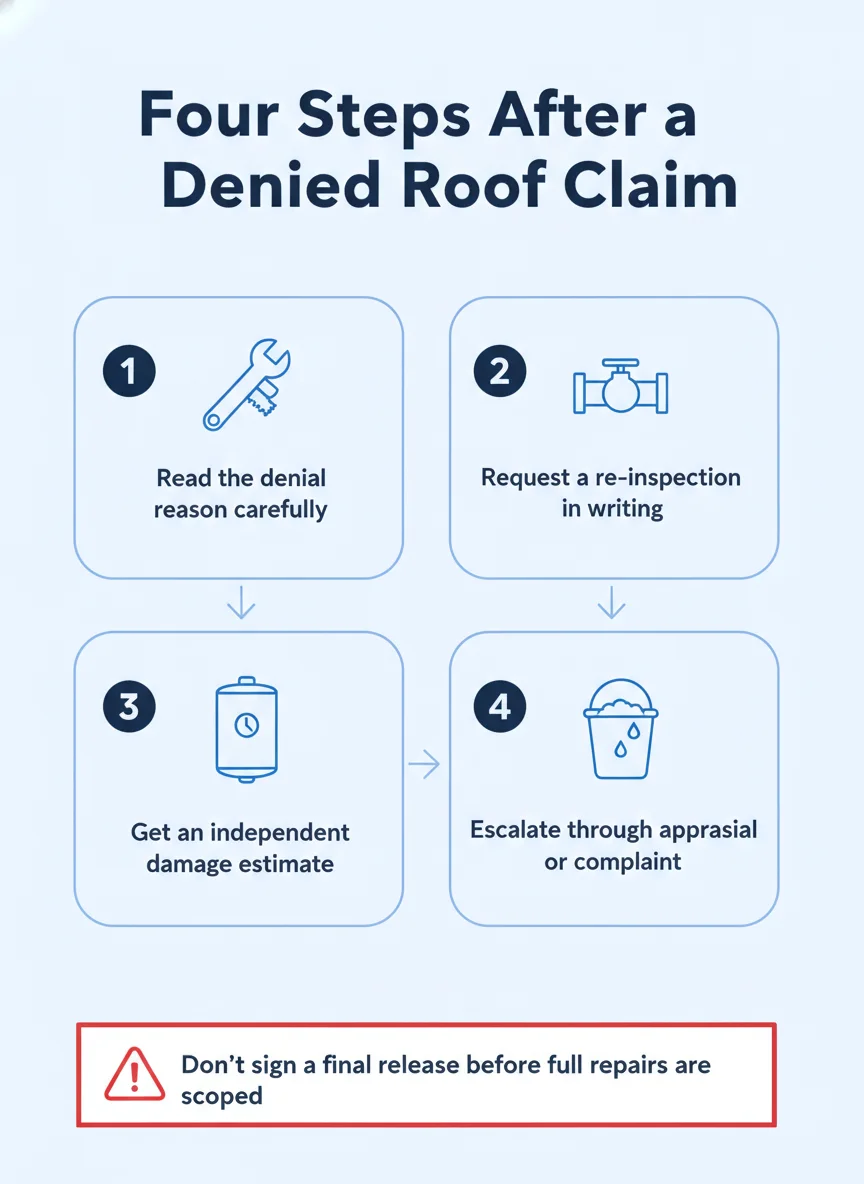
The order you take these steps in matters. Moving too fast to the final escalation options without building a documented record first tends to slow things down rather than speed them up.
- Read the reason stated: Find the exact language the denial or payout letter uses to justify the decision, since every later step depends on addressing that specific reasoning.
- Gather your own documentation: Photos, dates, and a written assessment from a licensed roofing contractor give you something concrete to counter the adjuster's report with.
- Request a re-inspection in writing: A written request creates a paper trail and puts the carrier on record that you're formally disputing the original finding.
- Submit a supplement if items were missed: An itemized estimate covering what the first report left out is the standard path for correcting an underpaid claim.
- Review your policy's appraisal clause: If the dispute is over value rather than coverage itself, appraisal lets both sides bring in independent appraisers to settle the number.
- Consider a public adjuster for complex claims: On claims involving extensive damage or repeated denials, a public adjuster's experience negotiating with carriers can carry real weight.
- File a state complaint as a last resort: If you believe the carrier is acting in bad faith, your state's insurance department has a process for reviewing complaints against licensed insurers.
What a Re-Inspection Report Should Actually Show
Once a re-inspection is scheduled, the quality of what gets documented matters more than just showing up. A thorough report doesn't just restate that damage exists, it ties specific findings to specific locations on the property, with enough detail that a second adjuster reviewing the file later can follow the logic without needing to visit in person.
What Strong Documentation Includes
Photos taken from multiple angles, close-up shots of damaged materials next to undamaged ones for comparison, and a slope-by-slope or area-by-area breakdown all strengthen a re-inspection file. Dates matter too, both the date damage is believed to have occurred and the date photos were taken.
A contractor's written estimate that breaks out materials, labor, and any related repairs (flashing, decking, ventilation) gives the carrier an itemized number to respond to directly, rather than a vague total that's easy to dismiss. This is the kind of detail our Roof Inspections & Maintenance visits are built to produce for homeowners heading into a dispute.
What Weakens a Dispute
Vague descriptions, missing dates, or photos that don't clearly show the damaged area all give an adjuster room to stand by the original decision. Waiting too long between the storm and the documentation also hurts, since conditions change and it becomes harder to tie damage to a specific date.
Homeowners who skip the written estimate step and rely only on a verbal description of what's wrong tend to have a harder time getting a supplement approved, simply because there's nothing concrete for the carrier to review against their own numbers.
What You Can Handle Yourself and When to Bring in a Pro
Homeowners can absolutely read their own policy, keep a timeline of events, and take their own photos right after a storm, before anyone else has stepped foot on the property. That early documentation is genuinely valuable and costs nothing but time.
Where it makes sense to bring in a professional is on the technical side: identifying whether damage pattern is consistent with wind or impact versus age, writing a code-compliant repair estimate, and knowing what a thorough slope-by-slope inspection actually requires. That's specialized knowledge most homeowners haven't had a reason to build, and it's exactly the gap a licensed roofing contractor fills.
Negotiating the legal terms of a policy, interpreting coverage language in a contested claim, or filing a formal complaint against a carrier is a different skill set again, more suited to a public adjuster or an attorney who works in insurance disputes. Knowing which lane you're in keeps you from spending time on the wrong fight.
Getting Your Claim Back on Track
A denial or a low payout feels like a closed door, but the claims process is built with more than one chance to get the number right. Re-inspections, supplements, and the appraisal clause exist precisely because first estimates are often incomplete, and homeowners who document carefully and escalate in the right order tend to see that reflected in the final outcome. For a fuller picture of how a claim typically moves from storm to repair, see the roof insurance claim timeline guide.
If you're working through a denied or underpaid claim anywhere from Dallas to the surrounding Metroplex, Renovacore Builders LLC can document the damage and provide the estimate a re-inspection or supplement needs.
Frequently asked questions
Why would an insurance company deny a roof claim?
Carriers commonly deny claims by classifying the damage as normal wear and tear, pre-existing, or cosmetic rather than storm-caused, or by arguing the damage falls below the threshold their policy requires for a covered loss. A denial letter should state the specific reason, and that reason is what you need to address if you push back.
What does it mean if my roof claim was underpaid?
An underpaid claim usually means the adjuster's estimate missed slopes, skipped components like flashing or ventilation, or priced materials and labor lower than what it actually takes to complete the repair. A supplement request with documentation is the standard way to ask the carrier to revisit the number.
Can a contractor help me fight a denied insurance claim?
A roofing contractor can document the damage, provide photos and an independent estimate, and point out anything the adjuster's report missed, but a contractor cannot negotiate your policy's legal terms or act as your attorney. For disputes that go beyond documentation, a public adjuster or an attorney who handles insurance matters is the appropriate next step.
What is the appraisal clause in a homeowners policy?
The appraisal clause is a dispute-resolution process built into most homeowners policies that lets you and your insurer each hire an independent appraiser to agree on the value of the loss when you disagree on the amount. It's generally faster and less costly than a lawsuit, though it only applies if your specific policy includes it.
How long do I have to dispute a roof insurance claim decision?
Timeframes for disputing a decision are set by your individual policy and by state insurance regulations, so the deadline that applies to you is printed in your policy documents or available from your state's insurance department. Acting quickly after a denial or lowball payment keeps more options open than waiting.