
Why So Many DFW Homeowners Don't Know Their Roof's Age
Across the DFW Metroplex, homes change hands often enough that the roof's history gets lost somewhere between the first owner and the fourth. A seller mentions the roof is "newer" without specifics, the closing paperwork gets filed away and forgotten, and five years later the new owner has no real answer when a home inspector or an insurance agent asks how old the roof actually is.
That gap matters more in North Texas than in milder climates. Sun exposure, temperature swings, and seasonal storms all wear on roofing materials faster than a mild coastal climate would, so a roof's real age is a bigger factor in how much life it has left. Before you can plan a budget, talk to an insurance adjuster, or decide whether a roof replacement makes sense, you need an actual number, not a guess based on when the house was built.
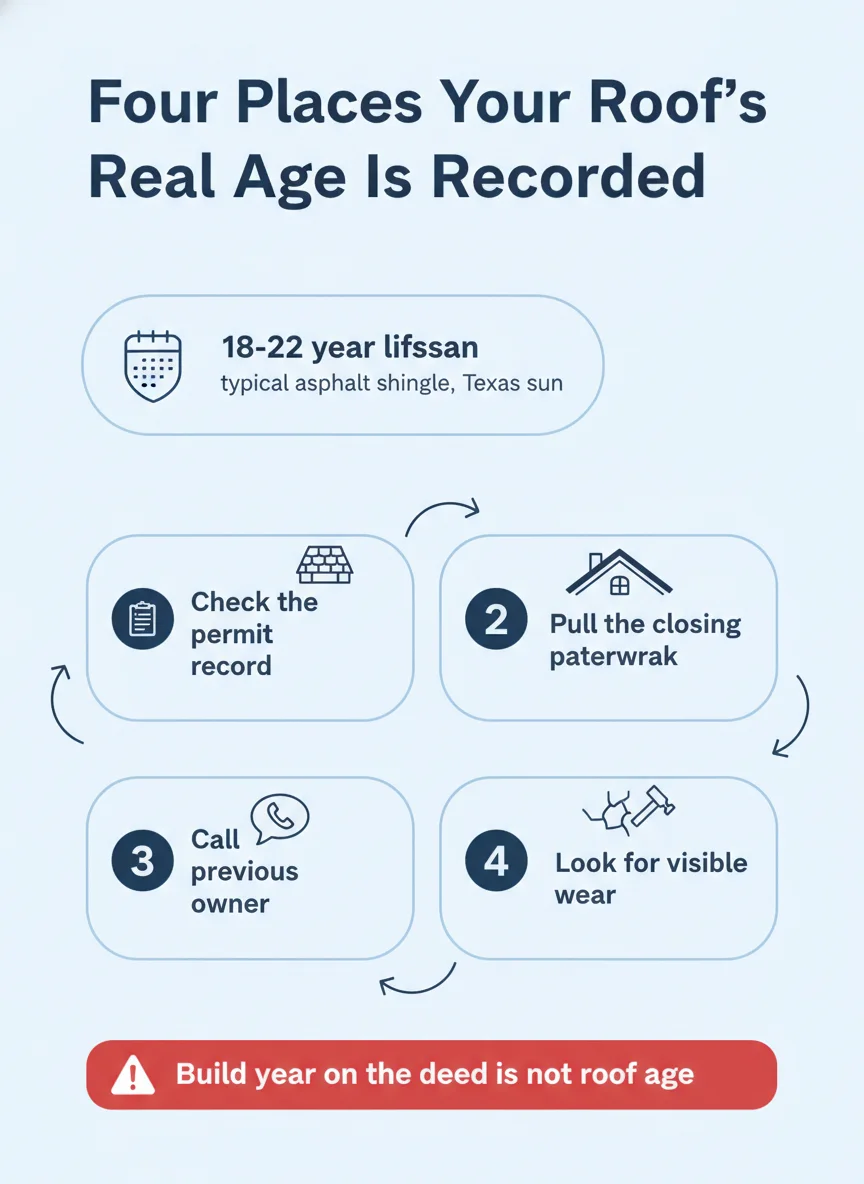
Why the Build Year on Your Deed Isn't the Answer
It's a natural assumption. You pull up your deed or your county appraisal record, see a construction year, and figure that's also when the roof went on. In reality, roofs almost never last as long as the house itself, so most homes have had the original roof replaced at least once, sometimes more, long before you ever bought the property.
The Construction Record Only Covers the Original Build
County appraisal and tax records log when a structure was built and sometimes when major permitted additions happened, but they rarely track routine replacements like roofing unless a permit was pulled and properly logged against the property. Treat the build year as background information only, never as a stand-in for roof age.
If a previous owner replaced the roof without pulling a permit, or if the permit was filed under a contractor's name rather than tied clearly to a roofing scope, that record can be incomplete or easy to miss during a basic property search.
Roofs Get Replaced on Their Own Timeline
A roof's replacement schedule depends on the material, the installation quality, storm history, and maintenance, none of which lines up with when the walls and foundation were poured. A 1985 house might have a roof from last year. A home built five years ago could already be on its second roof after a bad hailstorm.
That's why pinning down the actual install or replacement date takes a bit of digging rather than a single lookup. The good news is there are usually two or three places that date is written down somewhere, you just have to know where to check.
| Record Source | What It Tells You | How Reliable It Is |
|---|---|---|
| Building permit history | The date roofing work was approved or finaled with the city | Strong, when a permit was pulled and properly logged |
| Closing documents and disclosures | Seller-reported replacement date at time of sale | Moderate, depends on seller accuracy and memory |
| Previous owner or contractor invoice | Exact install date and sometimes material used | Strong, if you can track the document or the person down |
| Visual wear assessment | Approximate age range based on material condition | General estimate, best paired with a record |
What the Roof Itself Can Tell You
When paperwork comes up empty, the roofing material itself still holds clues. Granule loss, curling or lifting edges, and color fading are all signs of age on asphalt shingles, and a trained eye can usually narrow a roof down to a rough age bracket based on how worn those features are relative to typical material lifespans.
Flashing style, nail patterns, and underlayment visible at the eaves can also hint at the era of installation, since roofing codes and common practices shift over the decades. None of this replaces a hard date, but it's useful context, especially when combined with whatever partial records you do manage to find.
Step-by-Step: Tracking Down Your Roof's Real Age
Work through these in order. Most homeowners land on an answer within the first two or three steps without needing to go further.
- Pull your closing packet: Look through your home purchase paperwork for a seller's disclosure or inspection report, which often lists a roof age or replacement year reported at the time of sale.
- Search the permit record: Check your local building department's online permit portal by address for any roofing permits filed, which usually list an approval or final inspection date.
- Contact the previous owner: If you can track down the prior owner or their real estate agent, a direct question about roof history often produces a faster answer than paperwork digging.
- Look for a contractor invoice: Check any files left behind in the home, a garage folder, or an old email thread, since roofing invoices typically list the install date and materials used.
- Ask your insurance file: If a previous claim or policy renewal referenced the roof, your insurance company may have a recorded age or install year on file from a past inspection.
- Get a visual assessment: If records come up short, a roofer can estimate an age range based on wear patterns, which is useful even without an exact date.
What Different Signs Usually Mean
Once you've gathered whatever records and visual clues you can, it helps to know what they're pointing toward. The signs generally sort into two buckets: a roof that's likely getting close to the end of its service life, and one that still has years of useful life left.
Signs You're Probably Looking at an Older Roof
Widespread granule loss, multiple shingles curling at the edges, visible daylight through the attic decking, or a permit record showing the roof is pushing past the typical service window for its material all point to a roof nearing or past its expected lifespan. If you're seeing two or more of these together, it's worth scheduling an inspection sooner rather than later.
A roof in this range is also one where small repairs start to make less financial sense compared to planning for a full replacement, since patching an aging system tends to be a short-term fix on a roof that's already working against you.
Signs You're Likely Looking at a Newer Roof
A clean permit record from within the last several years, a disclosure statement citing a recent replacement, or shingles with consistent color and intact granule coverage all suggest you're dealing with a roof that still has substantial life ahead of it. In that case, your focus should shift from replacement planning to maintenance, routine inspections, and keeping any warranty paperwork on file.
Either way, documenting what you find now saves you from repeating this research later, whether that's for your own records, a future sale, or an insurance conversation.
What You Can Research Yourself vs. What a Roofer Should Confirm
The paperwork side of this is entirely something you can do on your own. Pulling permit records, reviewing closing documents, and reaching out to a previous owner all take time but no special skill, and they're often the most reliable way to land on a real date.
The visual assessment side is where a professional eye adds real value. Reading granule wear, flashing condition, and underlayment visible at the roof edges takes experience with a range of roofing ages and materials, and a homeowner climbing up for a look usually can't tell a 12-year-old roof from an 18-year-old one with any precision.
If you've exhausted the paperwork trail and still don't have a confident answer, that's the point to bring in a roofer for a firsthand look. It's a low-effort way to combine whatever documentation you found with a trained assessment of the material itself, and it gives you a far more accurate age range than guessing from the street.
Getting a Clear Answer Before You Need One
Finding your roof's real age isn't just trivia, it's the foundation for every other decision that follows: how much life is left, whether a repair vs. replace conversation is premature or overdue, and what your insurance company expects to see on file. The research takes an afternoon at most, and most of it happens from your kitchen table.
If you've dug through every record you can find for your home in Dallas or anywhere else in the Metroplex and still aren't sure what you're looking at, Renovacore Builders LLC can take a look and help you fill in the gaps.
Frequently asked questions
Does the year my house was built tell me the age of my roof?
No, and this is the most common mix-up homeowners make. A roof is replaced multiple times over the life of a house, so unless you have documentation of the original install date still being in place, the construction year on your deed tells you nothing about what's over your head right now.
Where is a roof replacement usually recorded?
Most roof replacements require a permit pulled with the local building department, and that permit typically lists the date the work was approved or finaled. Many building departments now let you search permit history online by address, which is often the fastest way to find a hard date.
What if there's no permit on file for my roof?
That doesn't necessarily mean the roof was never replaced, it may mean the work predates digital record-keeping or was done without a permit. Check your home inspection report from when you bought the house, your seller's disclosure, or ask the previous owner directly if you're still able to reach them.
Can a roofer tell how old a roof is just by looking at it?
An experienced eye can usually narrow it down by reading wear patterns, material condition, and installation style, but it's an estimate rather than an exact date. Combining a visual read with any paperwork you can track down gets you the most accurate picture.
Why does it matter if I know the exact age of my roof?
Knowing the age helps you plan for replacement before a leak forces the issue, and it matters for insurance, since many policies price coverage differently based on roof age. It also helps you evaluate whether a manufacturer or workmanship warranty is still active.