
What Does It Actually Take to Roof a House in the DFW Metroplex?
Roofing a house is a sequence of specific steps, not a single task, and the order matters as much as the materials. A crew has to remove what's there, check the structure underneath, seal every seam that water could find, and then install a covering rated for the climate it's going into. In the DFW Metroplex, that climate means baking summer heat, sudden hailstorms, and wind gusts strong enough to lift a poorly fastened shingle right off the deck.
Understanding the sequence helps homeowners in Dallas, Fort Worth, and the surrounding towns ask better questions when they're getting quotes. A contractor who skips steps to save a day of labor is making a bet with your home's weather protection, and that bet usually shows up as a leak two or three years down the road instead of twenty.
Why Do Some Roof Installations Last Decades While Others Fail Early?
The difference almost always comes down to what's underneath the visible surface, not the surface material itself. Two houses with identical shingles can age completely differently depending on whether the decking was sound, the underlayment was continuous, and the flashing was formed correctly around every penetration.
The Decking and Structure
Decking is the plywood or OSB layer that everything else attaches to, and it has to be solid, flat, and properly fastened before anything goes on top of it. Years of small leaks can soften decking without anyone noticing from the ground, which is why a tear-off that exposes the full deck matters more than it might seem.
Any soft or delaminated sections get cut out and replaced before the new system goes down. Nailing new material over weak decking is one of the fastest ways to end up with soft spots, sagging, and fasteners that back out within a few years instead of holding tight for decades.
The Underlayment and Flashing
Underlayment is the water-resistant barrier that goes between the decking and the final covering, acting as a backup layer if water ever gets past the top surface. It needs to run continuously across the whole roof, with extra layers at valleys and eaves where water concentrates and moves fastest.
Flashing is the metal detail work around chimneys, vents, skylights, and wall intersections, and it's where most leaks actually start. Properly formed and sealed flashing redirects water away from these transition points instead of letting it work its way underneath, which is a detail that's easy to rush and hard to inspect once the job is finished.
| Factor | Tear-Off Install | Roof-Over Install |
|---|---|---|
| Decking visibility | Fully exposed and inspected | Hidden, condition unknown |
| Weight on structure | One layer, standard load | Added layer, more weight |
| Typical lifespan | Full expected lifespan of material | Often shortened by trapped moisture |
| Labor and disposal | More labor, haul-off required | Less labor, no tear-off |
The Roofing System, Piece by Piece
A finished roof is really a stack of individual systems working together: the decking for structure, the underlayment for backup waterproofing, the flashing for transition points, the final covering for weather resistance, and ventilation to keep the attic from trapping heat and moisture. Each piece has a job, and none of them can fully compensate for a mistake in another.
Ventilation is the piece homeowners forget most often. Intake vents at the eaves and exhaust vents near the ridge let hot, moist attic air escape instead of cooking the underside of the decking all summer. A roof that looks perfect from the street can still be aging fast from underneath if the attic can't breathe.
Step-by-Step: How a Professional Roof Installation Happens
Here's the general order of operations a licensed crew follows on most roof replacement or roof installation projects, whether it's a single-family home or a small commercial building.
- Protect the property: Crews set up tarps and ground protection around landscaping, driveways, and windows before anything comes off the roof.
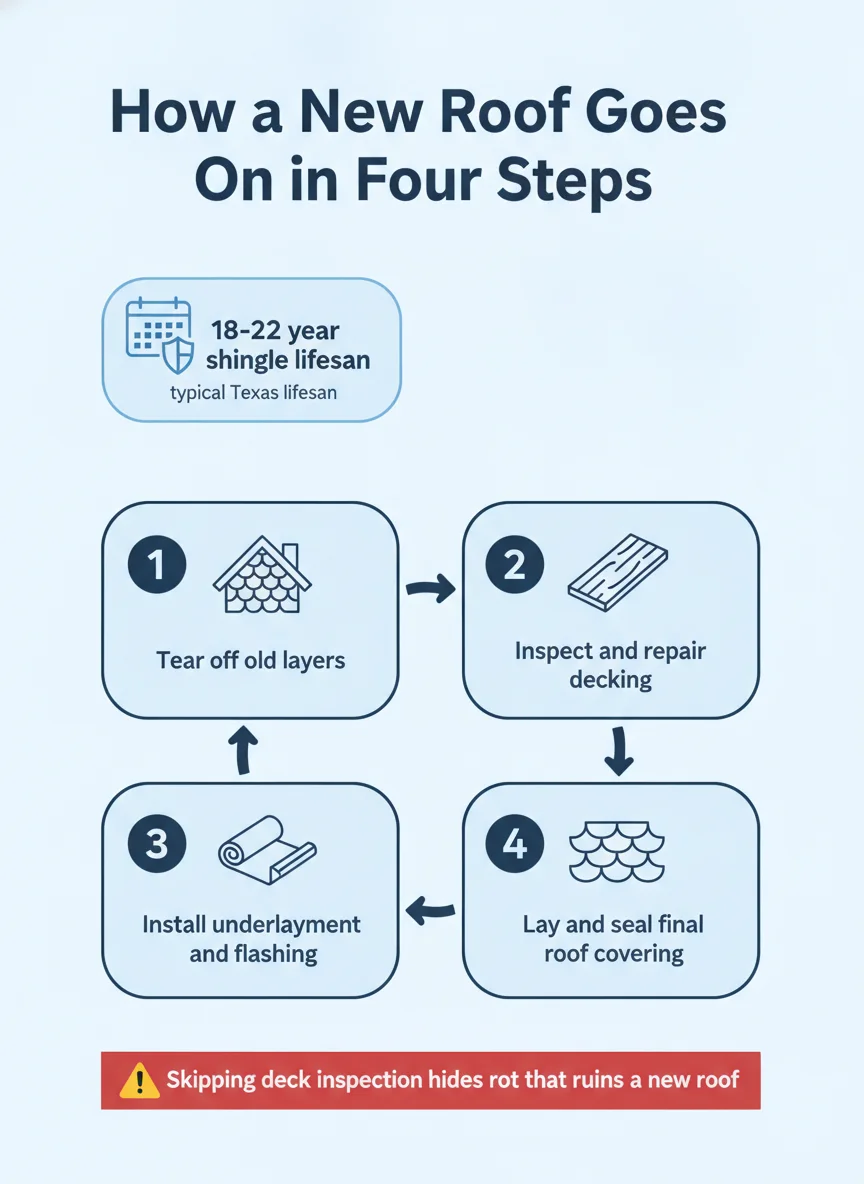
- Tear off old material: The existing covering comes off down to bare decking so the crew can see exactly what they're working with underneath.
- Inspect and repair decking: Any soft, rotted, or delaminated sections of decking get cut out and replaced with new material before moving forward.
- Install underlayment: A continuous water-resistant layer goes down across the whole deck, with extra protection at valleys, eaves, and low-slope areas.
- Form and seal flashing: Metal flashing gets shaped and installed around chimneys, vents, skylights, and wall transitions where leaks most commonly start.
- Lay the final covering: Shingles, metal panels, or membrane go down according to the manufacturer's fastening pattern and exposure requirements.
- Final walkthrough and cleanup: The crew checks ridgelines, seals, and fasteners, then clears debris and nails from the yard and gutters before leaving.
What You'll See During and After the Job
Signs the Install Went Right
A clean install shows straight, consistent lines across the covering, tight seams at valleys, and flashing that's been cut and formed rather than smeared over with sealant. Nail or fastener patterns should be even, and there shouldn't be visible gaps or exposed underlayment anywhere on the finished surface.
Afterward, the yard and gutters should be clear of nails and debris, and any landscaping that was covered during the job should be undisturbed underneath. A crew that takes cleanup seriously is usually the same crew that took the hidden steps seriously too.
Red Flags to Watch For
Watch for sealant used as a substitute for properly formed flashing, especially around chimneys and skylights. Caulk and roofing cement have a place for small touch-ups, but a bead of sealant covering a whole flashing joint usually means a step got skipped rather than solved.
Also watch for a crew that installs over obviously damaged decking without discussing it with you first. Any reputable contractor should show you rotted or soft sections before replacing them, not just quietly cover the problem and move on to the next section.
DIY vs Calling a Licensed Roofer
Small, ground-level tasks like clearing debris, checking gutters, or doing a visual check with binoculars after a storm are reasonable for most homeowners to handle themselves. These don't involve working at height or touching the structural or waterproofing layers of the system.
Anything involving tear-off, decking repair, flashing, or final covering installation should go to a licensed, insured crew. Working at height carries real fall risk, and mistakes in waterproofing details don't show up as a problem until months or years later, often as hidden rot that's far more expensive to fix than the roof itself would have cost.
A good rule of thumb: if the job requires a ladder tall enough to reach the eaves and tools beyond a broom, it's time to get a professional opinion. Many contractors offer a free look at the roof before quoting work, which is a low-risk way to find out what's actually going on up there.
Getting It Done Right the First Time
Roofing a house is a sequence of trade-offs between speed and durability, and the steps that get skipped are almost always the ones you can't see once the job is done. Decking repairs, continuous underlayment, and properly formed flashing cost more time up front, but they're the difference between a roof that lasts through its full expected lifespan and one that starts leaking a few years in.
Homeowners across Dallas, Fort Worth, and the wider region can get a sense of what a realistic timeline looks like by reading how long a roof replacement actually takes in Texas before scheduling anything. When it's time to get quotes compared or questions answered, Renovacore Builders LLC walks through each step above with homeowners before any work starts.
Frequently asked questions
Can I roof my own house in Texas?
Some homeowners do handle small repairs themselves, but a full roof installation involves structural decisions, code compliance, and safety risks that most people aren't equipped to manage alone. Texas does not require a state roofing license at this time, but a reputable contractor still carries general liability and workers' comp coverage that protects you if something goes wrong.
How long does it take to roof an average house?
Most residential installations wrap up in one to two days once materials are on site, though size, roof pitch, and weather can stretch that timeline. Commercial or multi-layer tear-offs typically take longer because there's more decking to inspect and more material to remove.
What's the first step in roofing a house?
The job starts with removing the old roofing material down to bare decking so the crew can see the condition of the wood underneath. Skipping this step and roofing over old material is one of the most common shortcuts that shortens a new roof's lifespan.
Do you need a permit to replace a roof in Texas?
Many Texas municipalities require a permit for roof replacement, and requirements vary by city, so it's worth checking with your local building department before work begins. A contractor familiar with your area should be able to tell you what's required and handle the paperwork.
What's the difference between roofing over and tearing off?
Roofing over means installing new material on top of what's already there, while a tear-off removes everything down to the decking first. Tear-offs cost more in labor but let the crew spot and fix hidden decking damage before it becomes a bigger problem.