
Why metal roofing keeps coming up in Texas
Across the Dallas-Fort Worth area and the rest of North Texas, homeowners deal with a specific combination of punishing summer heat, sudden hailstorms, and heavy seasonal rain. Asphalt shingles handle that mix reasonably well for a couple of decades, but metal roofing is built to handle it for much longer. That durability is why more homeowners in the DFW Metroplex ask about metal when it's time to replace an aging roof.
Metal roofing isn't new. It's been used on barns, commercial buildings, and coastal homes for generations because it resists wind uplift, sheds water fast, and doesn't rot or degrade from UV exposure the way organic materials can. What's changed is the range of styles available for residential use, which means metal no longer has to look like a pole barn to work on a house in a Texas neighborhood.
What's actually different between standing seam and screw-down panels
Both are metal roofing, but the way the panels attach to the roof changes almost everything else about performance, appearance, and price. Understanding the mechanism helps explain why one costs more than the other and why a roofer might recommend one over the other for a specific home.
Standing seam panels
Standing seam panels interlock along raised vertical ribs, and the fasteners are hidden underneath the seam rather than exposed to the weather. That concealed-fastener design is the main reason standing seam roofs last so long. Nothing is sitting on the roof surface for sun and rain to work on directly, so there's nothing to re-caulk or re-tighten every few years.
The interlocking seams also let the panels expand and contract with temperature swings without buckling, which matters in a climate that swings from freezing mornings to triple-digit afternoons. The tradeoff is a more involved installation process, since panels are often formed to length on site, which pushes the price higher than screw-down systems.
Screw-down (exposed-fastener) panels
Screw-down panels are fastened directly through the panel face with exposed screws and rubber washers. They're simpler to manufacture and install, which keeps the upfront cost lower and makes them a common choice for garages, workshops, and budget-conscious residential projects.
The downside is that every exposed fastener is a potential failure point. The rubber washers that seal each screw degrade from UV exposure over time, and once they start failing, water can work its way in around the screw holes. That means a screw-down roof typically needs the fasteners checked and occasionally replaced well before the panels themselves wear out.
| Factor | Standing Seam | Screw-Down |
|---|---|---|
| Fasteners | Concealed under the seam | Exposed through the panel face |
| Maintenance | Minimal, seams self-protect | Washers need periodic checking |
| Upfront cost | Higher | Lower |
| Typical use | Primary residential roofs | Outbuildings, budget projects |
How a metal roof system is actually built
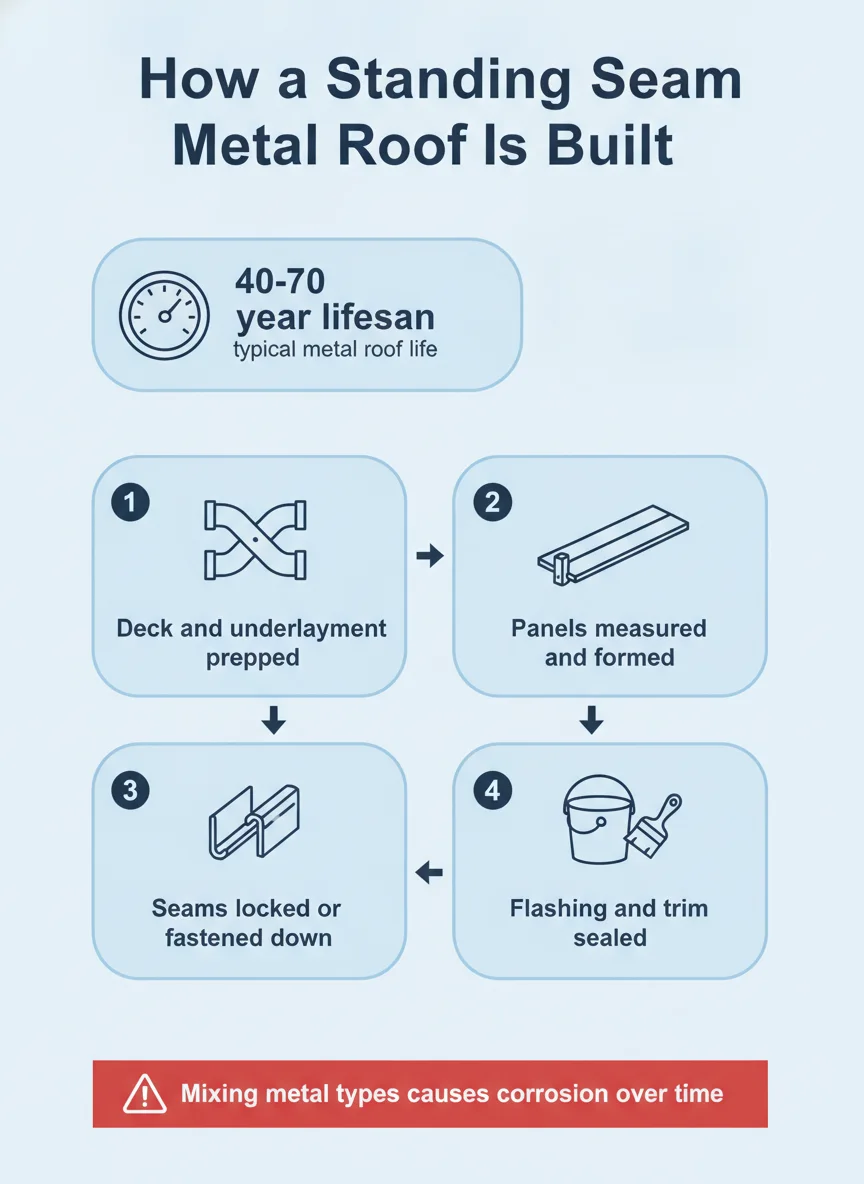
A residential metal roof isn't just panels nailed to the rafters. It starts with the same solid decking used under shingles, then a layer of synthetic or high-temperature underlayment that acts as a secondary water barrier. That underlayment is what keeps a metal roof quiet in rain and protects the deck if a panel seam or fastener ever lets water through.
On top of that, panels run from the ridge down to the eave so water sheds in one continuous path with as few horizontal seams as possible. Flashing at valleys, chimneys, and roof-to-wall transitions gets custom-formed to match the panel profile, since generic flashing doesn't seal as well against a ribbed metal surface. The quality of that flashing work is often what separates a metal roof that lasts decades from one that develops leaks within a few years.
Step-by-step: how a metal roof installation typically goes
The process looks similar whether you're going with standing seam or screw-down, though the panel-forming step differs. Here's the general sequence a homeowner can expect.
- Inspection and measurement: The crew checks the existing deck condition and takes precise measurements for panel lengths and roof slope.
- Tear-off or deck prep: Old roofing material is removed if needed, and the deck is repaired or replaced where it's damaged or soft.
- Underlayment installation: A synthetic or high-heat underlayment goes down across the entire deck as the secondary water barrier.
- Panel forming: Standing seam panels are often rolled to length on site; screw-down panels typically arrive pre-cut.
- Panel installation: Panels are set in sequence from eave to ridge, fastened or seamed according to the system type.
- Flashing and trim: Custom flashing is installed at valleys, penetrations, and edges to seal every transition point.
- Final walkthrough: The completed roof is inspected for proper seam closure, fastener torque, and clean trim lines.
What determines how a metal roof holds up over time
Metal roofing is tough, but it's not immune to damage, and knowing what to watch for helps you catch problems early.
Hail and impact resistance
Metal roofing generally resists hail penetration better than asphalt shingles, but large hail can still dent panels, especially on lighter-gauge screw-down products. Denting is mostly cosmetic and doesn't usually compromise the roof's water-shedding ability, but it's worth having checked after a significant storm, which is where a roof inspection earns its keep.
Heat, rain, and seasonal movement
Texas summers push roof surface temperatures well above the air temperature, and metal panels expand and contract daily as a result. Standing seam systems are engineered with clips that allow that movement without stressing the panel, while poorly installed screw-down systems can develop elongated screw holes over years of that same cycle. This is part of why choosing a roofing company with real metal roofing experience matters more than it does for a standard shingle job.
What a homeowner can handle versus what needs a licensed roofer
A homeowner can reasonably keep an eye on their metal roof from the ground, watching for loose panels after high wind, visible rust spots, or debris buildup in valleys that can trap moisture. Clearing debris off a low-slope section or cleaning gutters, where it's safe to reach without climbing onto the roof itself, is also fair game for most people.
Actual panel work is a different story. Re-securing a loose panel, replacing a failed washer, or repairing a seam requires matching the existing panel profile and fastener pattern exactly, and doing it wrong can create a leak where there wasn't one before. Flashing repairs around chimneys and vents are especially unforgiving of shortcuts, since a slightly misaligned flashing piece can funnel water directly into the deck instead of away from it.
If you're dealing with anything beyond surface debris or a visual check, it's worth having a roof repair professional take a look rather than climbing up with a tube of sealant. Metal roofing rewards precision, and small mistakes tend to show up as leaks months later rather than immediately, which makes them harder to trace back to the cause.
Deciding if metal is the right fit for your home
Metal roofing isn't the right answer for every budget or every home, but for homeowners planning to stay put for decades, the combination of durability, heat performance, and low maintenance makes a strong case in the Texas climate. Comparing it honestly against asphalt or other materials for your specific roof slope, budget, and timeline is the best way to land on the right call.
Renovacore Builders LLC works with homeowners across the DFW Metroplex weighing metal against other roofing systems and can walk through what makes sense for your specific property.
Frequently asked questions
Is a metal roof worth it in Texas?
For many homeowners, yes, because metal handles heat and heavy rain well and tends to outlast asphalt shingles by a wide margin. Whether it's worth it for your property depends on your budget, the look you want, and how long you plan to stay in the home.
Does a metal roof make a house hotter in summer?
No, a properly installed metal roof with good attic ventilation actually reflects more solar heat than many other materials. The reflectivity depends on the panel finish and color, with lighter, coated finishes performing best in Texas sun.
Is metal roofing loud when it rains?
Not usually, because modern metal roofs are installed over solid decking and underlayment, which absorbs most of the sound. The noise people associate with metal roofing mostly comes from older barn-style installs without a solid deck underneath.
Can you install metal roofing over an existing shingle roof?
It's sometimes possible with screw-down panels and furring strips, but it depends on the condition of the existing roof and local code requirements. A full [roof installation](/services/roof-installation) assessment will tell you whether a tear-off or an overlay makes more sense for your home.
How does standing seam compare to screw-down panels in cost?
Standing seam typically costs more upfront because of its concealed fastener system and more involved installation process, while screw-down panels are a lower-cost entry point into metal roofing. The right choice usually comes down to budget, expected lifespan, and how the home will be used.