Why financing comes up so often for DFW homeowners
A full roof replacement is one of the bigger bills a homeowner faces, and most people across the DFW Metroplex are not paying cash out of pocket for it. That means the question of which roofing company offers financing often matters just as much as who does the best work. The answer isn't a single name, it's a landscape of a few different funding paths, and knowing how each one works puts you in a much stronger position before you sign anything.
Financing availability also varies by company size and how long they've been in business. Some contractors partner with a lender and handle the paperwork in-house. Others point customers toward their own bank, a home equity line, or a card with a promotional rate. None of these are better or worse by default, they just fit different situations, and the right fit depends on your credit profile, the size of the project, and how soon the work needs to happen.
How roofing financing actually works
At a basic level, roofing financing is just a loan sized to the project, paid out to the contractor once work is approved and completed, and paid back by you over a set number of months. The structure matters more than the label on it.
Contractor-arranged financing
Many roofing companies work with one or more third-party lenders and can walk you through an application on the spot, sometimes during the same visit as your estimate. The contractor isn't the one lending the money, they're just the point of contact that makes the process convenient.
This path is popular because it's fast and because approval often happens before the crew even schedules the job. The tradeoff is that you're choosing from whatever lender relationships that specific contractor has set up, so it's worth comparing terms rather than assuming the first offer is the only one available.
Independent financing you arrange yourself
A home equity loan, a personal loan from your own bank or credit union, or a general-purpose credit line are all options you control directly, separate from whichever roofer you hire. This route takes more legwork up front but gives you full visibility into the rate and terms before a single shingle gets ordered.
Homeowners who already have a relationship with a lender, or whose project is tied to an insurance claim settlement, often lean this direction. It also keeps the financing conversation completely separate from the roofing quote, which some people prefer.
| Option | How it works | Good fit for |
|---|---|---|
| Contractor-arranged loan | Lender partner reviewed by the roofing company, application handled during the estimate | Homeowners who want speed and one point of contact |
| Home equity loan or line | Borrowed against home equity through your own bank or credit union | Larger projects where rate matters more than speed |
| Personal loan | Unsecured loan through a bank, credit union, or online lender | Smaller jobs or homeowners without significant home equity |
| Credit card with promotional rate | Short-term 0% or low-rate window offered by the card issuer | Smaller repair work paid off quickly |
What actually gets financed on a roofing project
Financing typically covers the full scope of the job, not just materials. That includes tear-off and disposal of the old system, the new roofing system itself, flashing and ventilation work, and labor. If a roof replacement also uncovers deck damage or structural repairs once the old layer comes off, that gets folded into the same loan request in most cases rather than billed separately.
What doesn't usually get financed is the estimate itself, since a legitimate roofer gives you that for free before any commitment is made. Knowing the difference keeps you from being pressured into a financing decision before you even have a clear number for the work.
Step-by-step: how to vet a roofer's financing offer
Before you sign a financing agreement tied to a roofing project, run through these checks. It takes an extra day or two but protects you from locking into terms you don't fully understand.
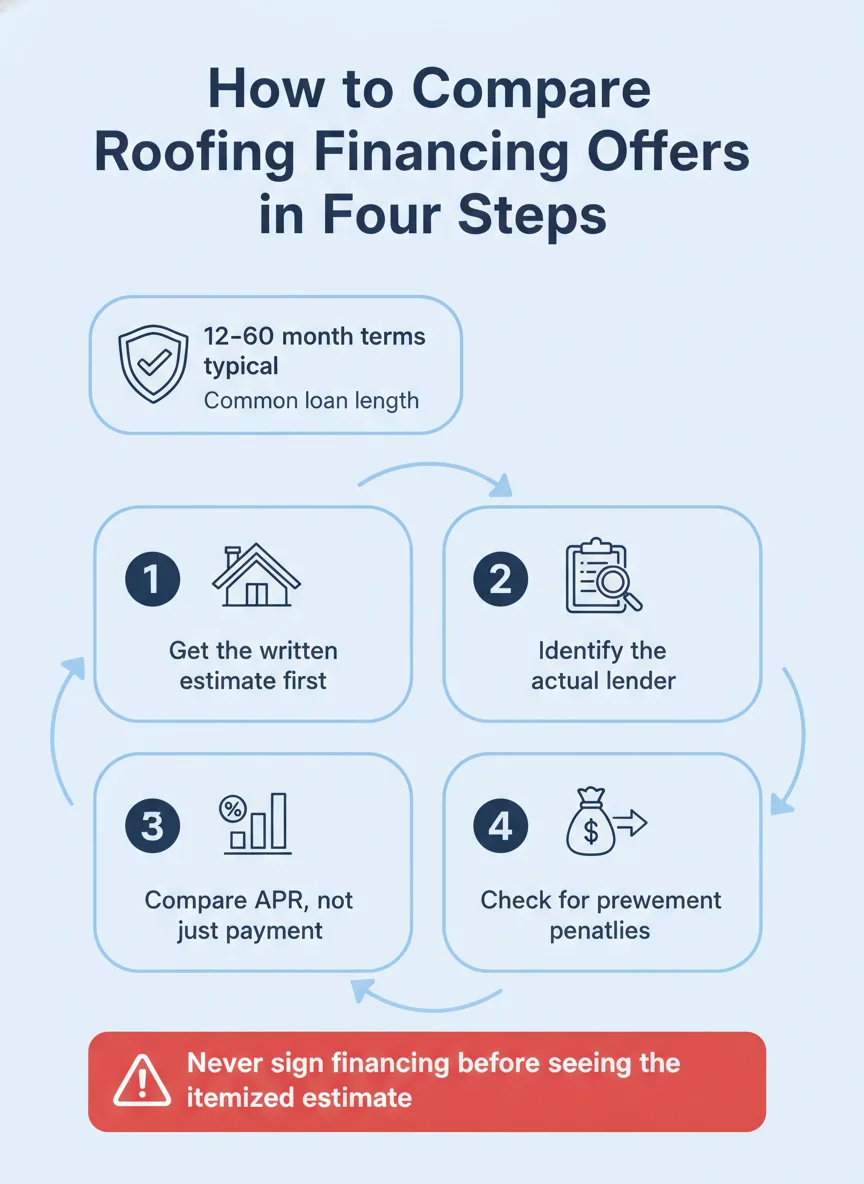
- Get the written estimate first: Make sure the scope of work and total project cost are clear before any financing paperwork enters the conversation.
- Ask who the actual lender is: The roofing company is usually a referral partner, not the lender, so confirm the name of the financial institution you'd be borrowing from.
- Request the APR and term length: Ask for the annual percentage rate and the number of months, not just the monthly payment figure, so you can compare it to other options.
- Check for prepayment penalties: Some loans charge a fee if you pay the balance off early, which matters if you plan to use insurance proceeds or savings to close it out sooner.
- Compare against your own bank: A quick call to your bank or credit union gives you a baseline rate to measure any contractor-arranged offer against.
- Read the default terms: Understand what happens if a payment is missed, including any deferred-interest clauses that can retroactively apply a higher rate.
What you'll find once you start comparing offers
Rates vary more than homeowners expect
Two lenders financing the same project size can land on noticeably different rates depending on your credit profile and the loan structure. This is the main reason it pays to get at least one comparison quote, even if the contractor's in-house option looks convenient.
Promotional zero-interest windows are common on shorter terms but often convert to a much higher deferred rate if the balance isn't paid off by the deadline. Read that fine print before assuming a 0% offer stays at 0%.
Insurance claims change the math
If your project is tied to a storm damage insurance claim, part or all of the job may already be covered, which reduces or eliminates the amount you'd need to finance. Work with your contractor to understand what the claim is expected to cover before deciding how much financing you actually need.
Homeowners sometimes finance the deductible portion only, which keeps the loan amount small and the terms simpler. That's worth discussing with whoever is handling your claim paperwork before you apply for anything larger.
What a homeowner can handle alone vs. what needs a pro
Researching lenders, comparing rates, and reading loan terms is something any homeowner can and should do on their own, no roofing expertise required. This part of the process is just financial homework, and the more of it you do upfront, the fewer surprises show up later.
What you shouldn't try to self-assess is the scope of the roofing work itself, meaning how much of the system actually needs replacing versus repairing. That call belongs to a licensed roofer who can inspect the deck, flashing, and ventilation and tell you honestly what the project requires, since an inflated scope inflates the loan you'd need in the first place.
A reputable contractor keeps those two conversations separate: an honest assessment of the work first, then a clear-eyed discussion of how you want to pay for it. If a company tries to bundle an inflated scope with an aggressive financing push, treat that as a reason to get a second opinion before committing to either.
Bringing it back to your project
There's no single roofing company that offers the only financing worth having. What matters is getting an honest scope of work, understanding every option on the table from contractor-arranged loans to your own bank, and comparing rates before you commit to anything. For a deeper look at what drives the overall number you'd be financing, see what affects roof replacement cost in Texas.
If you're weighing your options for a project anywhere across the DFW Metroplex, start with a free, no-obligation estimate from Renovacore Builders LLC so you know the real scope of the work before you talk financing with anyone.
Frequently asked questions
Do roofing companies offer their own financing?
Most roofing companies partner with a third-party lender rather than lending money themselves, and they help you apply during the estimate visit. The underlying loan still comes from a bank or financial institution, so it's worth asking who that lender actually is.
Is it better to finance through the roofer or my own bank?
It depends on the rate and terms each one offers, so the better move is comparing both rather than assuming one is automatically cheaper. Contractor-arranged financing is often faster, while your own bank may offer a lower rate if you have an existing relationship.
Can I finance just the insurance deductible instead of the whole project?
Yes, if your project is tied to an insurance claim, many homeowners only need to finance the deductible portion since the rest is covered by the settlement. Talk through the claim details with your contractor before deciding how much to borrow.
What credit score do I need for roofing financing?
Credit requirements vary by lender and loan type, so there's no single threshold that applies everywhere. Checking with a few different options, including your own bank, gives you a clearer picture of what you'd actually qualify for.
Should I get the estimate before applying for financing?
Yes, always get a written, itemized estimate before signing any financing agreement. Borrowing against a number you haven't confirmed in writing puts you at risk of financing more, or less, than the project actually requires.