
Why Roof Pitch Matters for DFW Metroplex Homes
Roof pitch is the angle of a roof's slope, and it drives almost every decision that comes after it, from which materials will hold up to how long an install takes. Across the DFW Metroplex, homes range from the low, broad slopes common on single-story ranch-style construction to steeper rooflines on two-story builds and newer subdivisions designed for curb appeal. A 30-degree pitch lands on the steeper side of that range, and it changes what a crew needs to bring to the job before they ever set foot on a ladder.
Homeowners usually run into the question of pitch when they're comparing quotes, researching a roof replacement, or trying to figure out why one estimate costs more than another for what looks like a similar-sized house. Degrees and the rise-over-run numbers roofers use day to day aren't the same language, and converting between them is the first step to understanding your own roof.
How Degrees Convert to the Rise-Over-Run Roofers Actually Use
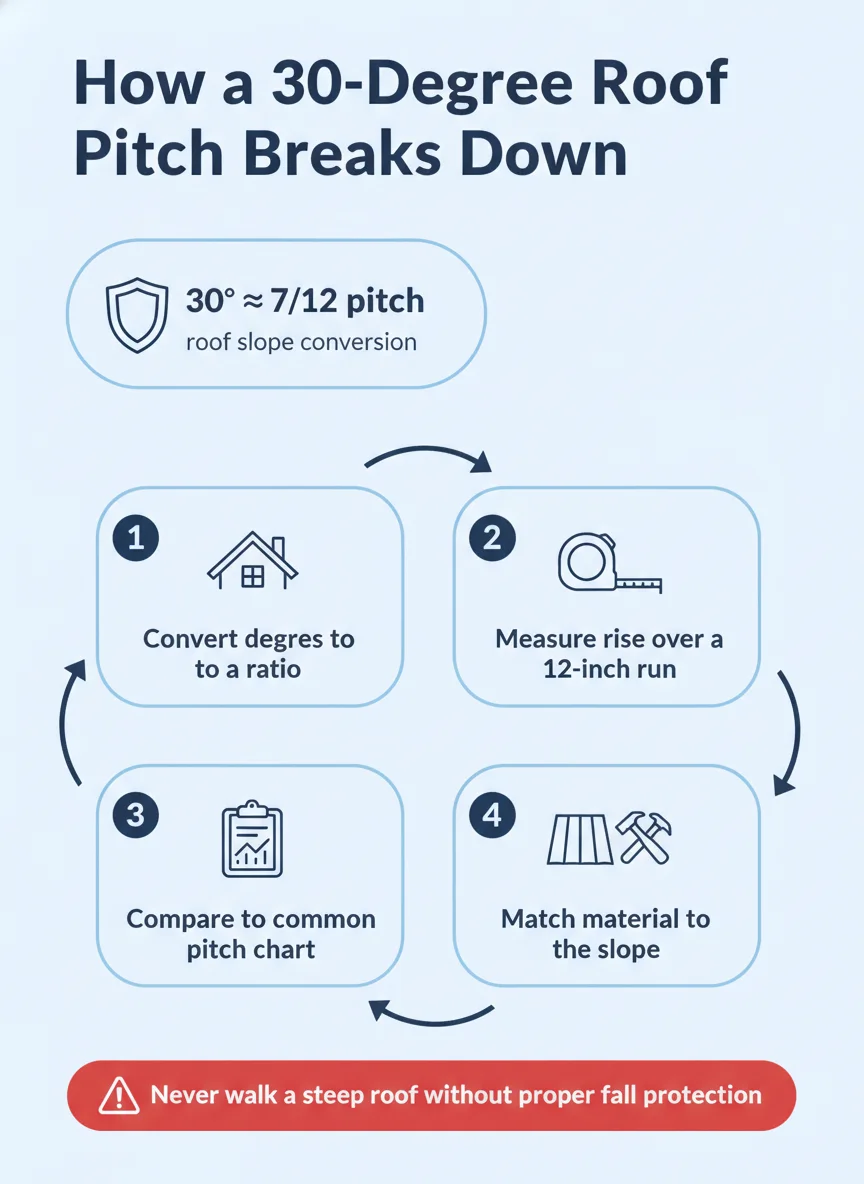
Roofing in the United States is almost always measured in rise over a 12-inch run rather than degrees, so a 30-degree angle needs to be translated before it means much on a job site. The math uses the tangent of the angle, and 30 degrees works out to a rise of roughly 6.93 inches over a 12-inch run, which gets rounded to a 7-in-12 pitch in everyday use.
Where 7-in-12 Falls on the Pitch Spectrum
A 7-in-12 pitch is steeper than the 3-in-12 to 5-in-12 slopes that show up on a lot of single-story homes, but it's nowhere near the dramatic 12-in-12 pitches you'll see on some custom builds or A-frame structures. It's a common, workable slope that shows up across both older and newer construction in North Texas.
At this angle, water and debris shed off quickly, which is good for long-term roof health, but the surface is steep enough that walking it safely requires the right footwear, rope-and-harness setups, or roof jacks depending on the material. That's a meaningful difference from a near-flat commercial roof or a low-slope ranch home.
Why the Exact Number Matters for Estimates
When a contractor measures your pitch during an estimate, they're not just satisfying curiosity. The number determines fastening patterns, how much underlayment overlap is needed, and whether certain materials are even rated for the slope. A roof at 7-in-12 and a roof at 4-in-12 can require different approaches even if they're the same square footage.
This is also why a written estimate should always follow an actual site visit rather than a phone quote. Pitch, access, and the condition of the decking underneath all factor into labor time, and none of that shows up in a photo or a square-footage number alone.
| Pitch (rise/run) | Approx. degrees | Typical use |
|---|---|---|
| 3-in-12 to 4-in-12 | 14° to 18° | Low-slope ranch homes, some additions |
| 6-in-12 | 27° | Common moderate residential slope |
| 7-in-12 (≈30°) | 30° | Steeper residential slope, strong drainage |
| 12-in-12 | 45° | Steep, dramatic rooflines, A-frame style |
What a 30-Degree Pitch Means for the Roof System Underneath
The slope angle affects more than the surface material. Underlayment, flashing details, and ventilation design all respond to how steep a roof is. At 7-in-12, water moves off the roof fast enough that standing water is rarely a concern, which simplifies some flashing decisions compared to a low-slope or flat section.
Ventilation still matters just as much at this pitch, since attic heat buildup is driven by insulation and airflow, not slope angle alone. A steeper roof does have more attic volume to work with in many cases, which can actually make balanced intake and exhaust ventilation easier to achieve than on a very low-slope design.
Step-by-Step: How to Check Your Own Roof's Pitch
You don't need to get on the roof to get a rough pitch reading. A level, a tape measure, and a little patience from the ground or an attic vantage point will get you close enough to understand what range you're in.
- Find a clear gable: Look for a section of roof you can view clearly from the ground, ideally the gable end where the slope is visible in profile.
- Grab a torpedo level: Use a small level and a tape measure, or ask someone to help hold them steady against the roof surface.
- Hold the level flat: Place the level horizontal against the underside of the roof deck, extending it out 12 inches from the edge.
- Measure the rise: At the 12-inch mark, measure straight down to the roof surface. That number in inches is your rise over a 12-inch run.
- Compare to a pitch chart: Match your rise number to a standard pitch chart to find both the ratio and the approximate angle in degrees.
- Confirm with a professional: For anything beyond a rough estimate, especially before choosing materials, have a roof inspection confirm the exact number.
What You'll Find When You Diagnose a 7-in-12 Roof
Signs the Pitch Is Working in Your Favor
On a well-maintained roof at this slope, you should see clean, fast runoff after rain with no standing water anywhere on the field of the roof. Debris like leaves and small branches tends to slide off rather than accumulate in low spots, which keeps moisture from sitting against the material.
Flashing around chimneys, vents, and valleys should still be doing its job of directing water around penetrations rather than relying on the slope alone to solve every drainage point. A steep pitch reduces some risks but doesn't eliminate the need for solid flashing work.
Signs the Pitch Is Working Against an Aging Roof
If you notice granule buildup in gutters, curling at shingle edges, or nail pops along the steeper sections, that's often wear showing up faster on a steep slope because of greater sun and wind exposure compared to a shaded, low-slope section of the same house.
A steep roof that's showing isolated damage, like a section near a valley or an edge exposed to prevailing wind, is a reasonable candidate for roof repair rather than full replacement, assuming the rest of the system is sound.
DIY vs. Calling a Pro for Pitch Questions
Measuring your own pitch with a level and tape measure is a reasonable DIY task, and it's a good way to understand your home before a contractor shows up. It won't put you in danger as long as you're doing it from the ground or a stable attic vantage point rather than standing on the roof itself.
Where this becomes a job for a licensed professional is anything involving actually walking the slope, whether that's for a closer inspection, repair, or a full tear-off. A 7-in-12 pitch is steep enough that proper harnessing and roof jacks matter, and a professional crew carries that equipment as a matter of course.
Material selection is the other place where it pays to bring in a pro early. The right call on asphalt versus metal versus another system depends on more than pitch alone, including your home's structure, climate exposure, and long-term plans for the property.
Getting an Exact Reading Before You Plan Work
A rough pitch estimate is useful for understanding your home, but any real project, whether it's a patch repair or a full roof installation, deserves an exact number measured on-site. That's also the point where a contractor can walk the roof safely, check decking condition, and give you a clear picture of what the project actually involves.
If you're in McKinney or anywhere else across the DFW Metroplex and want a straight answer on your roof's pitch, material options, or condition, Renovacore Builders LLC can take a look and walk you through what it means for your home. For more on choosing between repair and replacement once you know your pitch, see our guide on missing shingles after a windstorm.
Frequently asked questions
What roof pitch is 30 degrees in inches per foot?
A 30-degree angle works out to roughly a 7-in-12 pitch, meaning the roof rises about 7 inches for every 12 inches of horizontal run. It's considered a moderately steep slope, steeper than the 4-in-12 to 6-in-12 range common on many ranch-style homes.
Is a 30-degree roof pitch steep?
Yes, a 30-degree pitch sits on the steeper end of residential roofing and is noticeably more aggressive than the low slopes used on most single-story ranch homes. It's still well within the range asphalt shingles, metal, and most standard materials are designed to handle.
Does a steeper roof pitch cost more to install?
Generally yes, because steeper slopes take longer to work on safely and require more fall-protection setup and material handling. The exact cost difference depends on the roof's size, access, and the material chosen, which is why an in-person look always beats a phone estimate.
What roofing materials work best on a 30-degree pitch?
Most standard materials, including asphalt shingles and metal panel systems, perform well at this slope since water sheds quickly and doesn't pool. The main consideration shifts from drainage, which is rarely an issue here, to wind uplift resistance and proper fastening given the steeper exposure.
How do I measure my roof's pitch at home?
You can get a rough measurement with a torpedo level and a tape measure by holding the level horizontal against the roof surface and measuring the vertical rise at the 12-inch mark. For an exact number and a safety check, it's worth having a roofer confirm it during an inspection.