
Why Impact Ratings Matter for Texas Roofs
North Texas sees more than its share of severe spring storms, and hail is one of the main reasons roofs in the DFW Metroplex get replaced ahead of schedule. That's pushed more homeowners to ask about impact-resistant shingles, often labeled Class 4, when they're due for a roof replacement or new install.
The rating gets tossed around a lot in sales conversations, sometimes with more confidence than the test behind it actually supports. Understanding what Class 4 really measures helps you decide if it's worth paying for, and keeps you from assuming a roof is tougher than it actually is just because of a label on the wrapper.
What Actually Earns a Shingle Its Class 4 Rating
The rating comes from a standardized lab test, not a storm simulation on an actual roof. Manufacturers submit shingle samples to get them classified from 1 to 4, with 4 being the highest level of impact resistance currently recognized.
The UL 2218 Steel Ball Test
The test drops steel balls of different sizes from set heights onto a shingle sample to simulate hail impact. To earn a Class 4 rating, the shingle has to resist cracking or splitting through two impacts in the same spot using the largest steel ball used in the test.
It's a pass or fail test, not a measurement of exactly how much hail a roof can take before damage shows up. A shingle can pass the test and still show granule loss, bruising, or cosmetic wear after a real hailstorm, which is an important distinction when you're weighing the upgrade.
What Class 4 Does and Doesn't Protect Against
What it protects against is cracking and splitting from impact, the kind of damage that leads to active leaks right after a storm. That's the main risk the rating is designed to reduce, and it's a real, measurable benefit for roofs in hail-prone regions.
What it doesn't guarantee is protection from every type of storm damage. Wind uplift, granule loss, and cosmetic bruising can still happen on a Class 4 roof, and large enough hail can still cause problems regardless of rating. Think of it as added resistance, not immunity.
| Rating | What It Means | Typical Shingle Type |
|---|---|---|
| Class 1-2 | Resists smaller impact sizes in the lab test | Standard three-tab or basic architectural |
| Class 3 | Resists moderate impact sizes | Mid-grade architectural shingles |
| Class 4 | Resists the largest steel ball size used in testing, including two impacts in the same spot | Reinforced architectural or designer shingles |
What Changes Inside a Class 4 Shingle
To pass the higher-level test, manufacturers typically use a reinforced fiberglass mat, modified asphalt, or added polymers that make the shingle more flexible under impact instead of brittle. The goal is a shingle that absorbs the hit rather than cracking on contact.
These changes usually come packaged into architectural or designer-grade shingle lines rather than basic three-tab products, since the reinforced construction naturally fits a heavier, more dimensional shingle. If you want a side-by-side on grade differences beyond impact rating, our post on three-tab, architectural, and designer shingles breaks down what else separates those tiers.
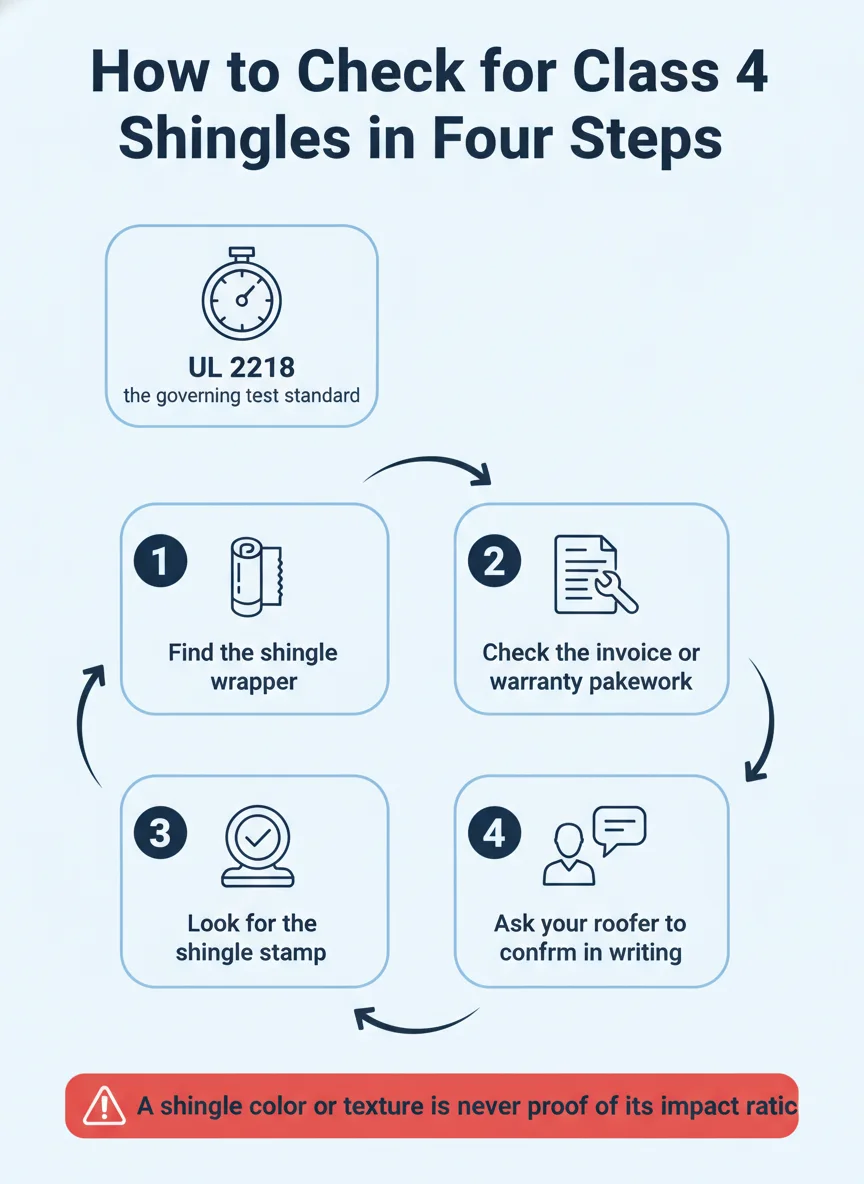
Step-by-step: How to Tell If a Roof Already Has Class 4 Shingles
If you bought a home with an existing roof, there's no need to guess. A few checks usually confirm the rating without tearing anything apart.
- Check the attic or garage: Leftover shingle wrapper from the original install often lists the product name and class rating directly on the packaging.
- Pull the original invoice: If you have paperwork from the install or a previous sale disclosure, the product name is usually listed and can be looked up.
- Look for a shingle stamp: Some manufacturers print a small rating mark on the back of the shingle itself, visible if a tab is lifted carefully.
- Search the product name: Once you have a manufacturer and product line, a quick search of that product confirms its UL rating.
- Ask a roofer to confirm: If none of the above turns up an answer, a roofer can usually identify the shingle type and rating during a routine inspection.
What You'll Find When You Check
Checking the Wrapper and Paperwork
Most homeowners who still have the original wrapper or invoice get a clear answer fast, since manufacturers print the product name prominently. That name is enough to look up the exact UL classification without needing anyone on the roof.
If the home changed hands more than once, this paperwork is often missing. That's common, and it's not a dealbreaker, it just means the next step is a visual check instead of a paper trail.
Checking the Shingle Itself
A stamp on the back of the shingle is reliable when it's visible, but not every manufacturer or product line includes one, and it's not something to go hunting for without the right footing and safety gear.
This is really where a trained eye helps. During a roof inspection, identifying shingle type and rating is a quick part of a broader look at the roof's overall condition, not a separate trip.
DIY vs Calling a Pro
Pulling an old wrapper from the attic or checking an invoice is something any homeowner can do safely on their own time. If that paperwork exists, it's often the fastest way to confirm what's already on the roof without anyone climbing a ladder.
Getting onto the roof itself to check for a manufacturer stamp is a different story. Loose footing, steep pitch, and brittle older shingles are a bad combination for anyone without the right harness and experience, and a misstep can cause more damage than the check was worth.
If you're deciding whether to upgrade to Class 4 for an upcoming roof installation, that's a conversation worth having with a roofer who can walk you through product options and what makes sense for your specific roof and budget, rather than guessing based on marketing claims alone.
Is the Upgrade Worth It for Your Roof
For homes in hail-prone parts of Texas, including much of the Plano area and the wider DFW Metroplex, the added durability of Class 4 shingles can mean fewer cracked or split shingles after a bad storm season, and some insurers offer a credit for the upgrade, though that varies by provider and policy.
Whether it's worth the added material cost depends on your specific risk, how long you plan to stay in the home, and what your insurer actually offers for the upgrade. Renovacore Builders LLC can walk through the options available for your roof during a free estimate, so you're making the call with real information instead of a sales pitch.
Frequently asked questions
Does Class 4 mean the shingle is hail-proof?
No, Class 4 means a shingle resisted cracking or fracturing in a specific lab test using steel balls dropped from set heights. It does not mean the shingle is immune to bruising, granule loss, or damage from larger hail in real storms.
How can I tell if my roof already has Class 4 shingles?
Check the leftover wrapper in the garage or attic, the original invoice, or the shingle itself for a manufacturer stamp. If none of those are available, a roofer can usually identify the product during an inspection.
Do Class 4 shingles cost more than standard shingles?
Generally yes, since they use reinforced materials and go through additional testing, but the exact difference depends on the manufacturer and product line. The best way to compare is to ask for pricing on both options during the same estimate.
Will insurance automatically give me a discount for Class 4 shingles?
Some insurers offer a discount or credit for impact-resistant roofing, but this varies by company and policy, so it's not guaranteed everywhere. Check directly with your insurance provider to see what applies to your policy.
Are Class 4 shingles worth it in Texas?
For homeowners in hail-prone parts of the state, the added durability and potential insurance credit can make the upgrade worthwhile over the life of the roof. It comes down to weighing the material cost against your specific risk and how long you plan to stay in the home.