
Why Nail Length Matters for a Shingle Roof
It's an easy thing to overlook. A nail is a nail, right? But on an asphalt shingle roof, fastener length is one of the quiet details that decides whether a roof holds together in a summer thunderstorm or sheds shingles into the yard. Texas weather doesn't make this easier. The DFW Metroplex sees swings from triple-digit heat that softens asphalt to straight-line winds that test every fastener on the field.
The right nail reaches through the shingle and the underlayment and seats fully into solid decking below. Too short, and it never grabs enough wood to hold. Too long, and it can punch through the decking entirely. Neither is something a homeowner can check from the ground, but it's worth understanding before a Roof Replacement or repair, because it's one of the basics that separates work that lasts from work that doesn't.
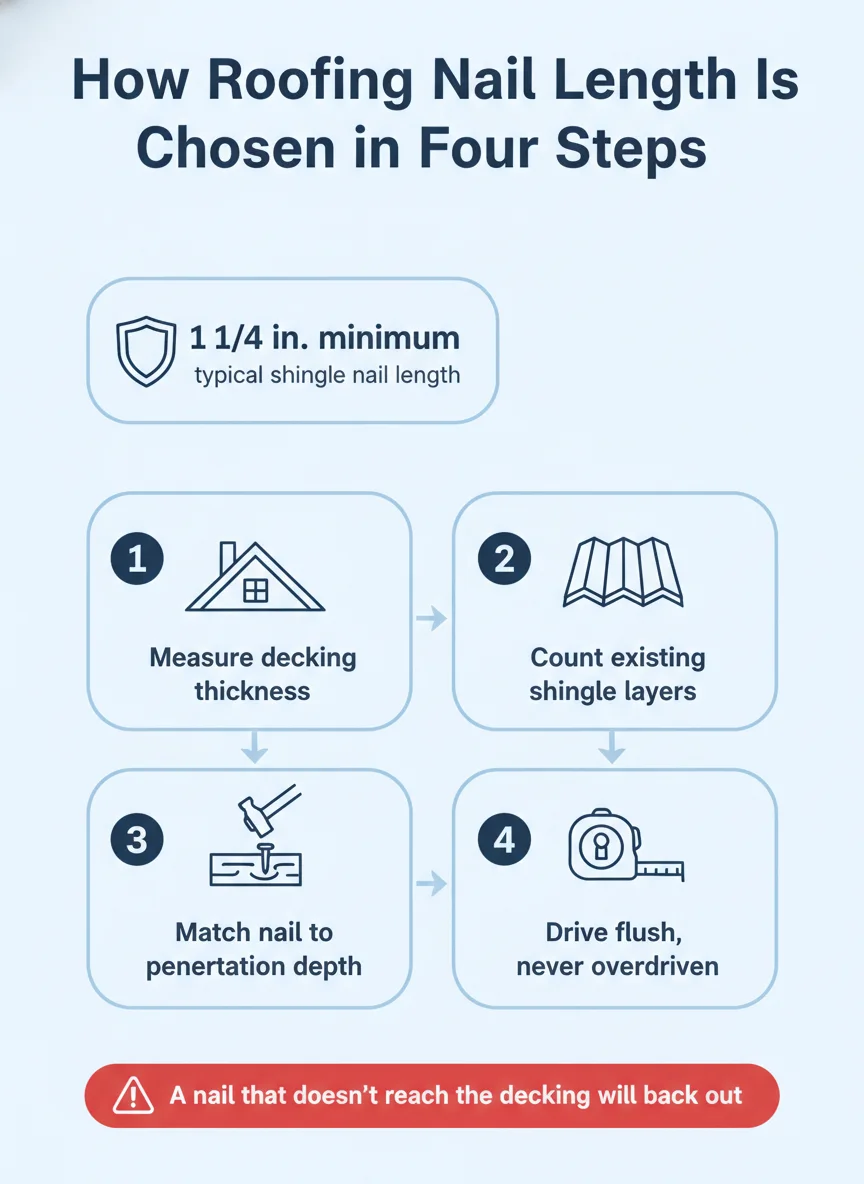
What Actually Determines the Right Nail Length?
Nail length isn't a single fixed number across every roof. It's calculated from a few physical factors on the specific house, and getting it wrong in either direction causes problems down the road.
Decking Thickness and Shingle Layers
The first variable is how thick the roof decking is. Standard plywood or OSB decking is typically a half inch to five-eighths of an inch thick, and the nail needs to pass fully through it. If there's an existing layer of shingles left in place (a roof-over rather than a tear-off), that adds more material the nail has to pass through before it ever reaches wood.
This is part of why a full tear-off, removing old material down to the decking, tends to produce a more reliable fastening job than nailing a new layer over an old one. It's also why a roofer needs to know exactly what's underneath before setting up the nail gun, not guess at it.
Nail Type and Shank Style
Shank style matters almost as much as length. Smooth-shank nails are more prone to backing out over time as wood expands and contracts with heat. Ring-shank nails have raised rings along the shaft that bite into the decking and resist pull-out, which matters a lot in a climate with the temperature swings Texas gets.
Galvanized coating is also standard for roofing nails because it resists rust. A rusted nail head can stain the shingle above it and eventually weaken enough to let the shingle lift. None of this is exotic material, it's just the baseline spec for a fastener meant to sit on a roof deck for decades.
| Situation | Typical Fastener Need | Why It Changes |
|---|---|---|
| New install, single layer, standard decking | Nail fully penetrates decking by about 3/4 inch | Standard spec for most residential roofs |
| Roof-over, one old layer left in place | Longer nail to clear old shingles plus decking | Extra material between nail head and wood |
| Thicker decking (older homes, commercial) | Longer nail to maintain full penetration | Decking thickness varies by build era and structure |
| High-wind or coastal-rated shingle lines | Manufacturer-specified nail pattern and count | Wind rating depends on fastening as much as material |
The Fastener Itself: What a Good Roofing Nail Looks Like
A roofing nail isn't the same as a framing nail or a general construction nail. It has a wide, flat head, usually around three-eighths of an inch across, designed to sit flush against the shingle surface without tearing through the asphalt mat. That wide head spreads holding pressure across more surface area, which is part of what keeps a shingle locked down.
The shank is typically 11 or 12 gauge steel, thick enough to resist bending when it's driven by hand or by a pneumatic nailer. Combined with a galvanized or stainless coating and the right shank style, this is a fairly simple piece of hardware doing a job that has to hold for the full life of the roof system, not just the first storm season.
Step-by-Step: How a Nail Gets Sized and Driven Correctly
On a well-run job, choosing and setting fasteners follows a consistent sequence rather than guesswork. Here's roughly how that process goes from the decking check to the finished course.
- Check the decking: The crew confirms decking thickness and condition before fastening begins, since a soft or damaged deck changes the plan.
- Count existing layers: Any old shingle layer left in place gets factored into the nail length so penetration into solid wood stays full.
- Select nail length and type: A ring-shank, galvanized nail of appropriate length is chosen to match the decking and layer count on that specific roof.
- Set nail placement: Nails go in the manufacturer's specified zone on each shingle, typically just below the sealant strip, in the correct count per shingle.
- Drive flush, not overdriven: The nail head sits flush with the shingle surface. Overdriving crushes the mat and weakens the hold.
- Check exposure: Each course is checked for proper exposure and alignment so fasteners land in the double-thickness zone, not a single layer.
- Final walk: A final pass checks for any nail heads sitting proud of the surface or missed fastening points before the job wraps.
What Goes Wrong When Nail Length Is Off
Nails Too Short
A nail that doesn't fully reach solid decking has nothing to grip. Over time, especially with the heat cycling common across North Texas summers, a short nail can back out partway, lifting the shingle tab above it. That raised edge catches wind, and once one shingle starts lifting, nearby shingles are more exposed too.
Short nailing is also one of the more common findings during a Roof Inspections & Maintenance visit, because it's not visible from the ground and shows up only when someone checks individual courses up close. It's one reason periodic inspection catches problems before a full section of shingles comes loose.
Nails Too Long or Overdriven
The opposite problem is a nail that passes all the way through the decking and pokes into the attic space below. That's a safety hazard for anyone working in the attic and can also become a spot where moisture tracks in along the shank. Overdriving, where a pneumatic nailer sets the head too deep and crushes into the shingle mat, is a separate but related issue that weakens the shingle at the fastening point even with a correctly sized nail.
Both problems trace back to the same root cause: fastening done fast without checking the specifics of that particular roof. Neither shows up in a quick visual from the curb, which is part of why a hands-on look matters more than a drive-by estimate.
DIY vs. Calling a Pro for Fastening Issues
A homeowner can sometimes spot early warning signs from the ground, like a shingle tab that looks slightly raised or a row that doesn't lie flat compared to the ones around it. Binoculars from the yard or a look from a second-story window can flag something worth a closer look without anyone climbing up.
Actually fixing a fastening problem is a different matter. Re-nailing a shingle correctly means lifting the tab without tearing the sealant strip, matching the original nail pattern, and resealing the adhesive so the shingle locks back down. Doing that wrong can cause more leaks than it solves, and working on a sloped roof carries real fall risk that isn't worth taking on solo.
A Roof Repair visit from a licensed crew covers this kind of targeted fix without requiring a full tear-off, assuming the rest of the roof is sound. It's also the right time to ask about the overall fastening condition of the roof, not just the one spot that's visibly lifted.
The Bottom Line on Nail Length
Nail length is one of those details that nobody notices until it fails, and by then it usually means a shingle somewhere in Dallas or another DFW-area neighborhood has already worked itself loose. It's a small spec with an outsized effect on how long a roof actually lasts compared to how long it was supposed to last.
If a roof is due for a closer look, whether that's a full Roof Replacement or just a check on fastening after a windy stretch, it's worth reading up on related topics like what happens on roof replacement day to know what to expect. Renovacore Builders LLC can take a look and explain exactly what's holding, and what isn't, before anything gets worse.
Frequently asked questions
What length roofing nail do I need for asphalt shingles?
Most asphalt shingle installs use a nail that's at least 1 1/4 inches long, which is enough to fully penetrate standard plywood or OSB decking plus the shingle itself. The exact length can run longer if there's a second layer of shingles underneath or if the decking is thicker than standard.
Can roofing nails be too long?
Yes, a nail that's too long can poke through the underside of the decking into the attic space, which creates a sharp hazard and a potential path for moisture. The goal is full penetration through the decking without excess length sticking through.
Does nail length affect wind resistance?
It does, because a nail that doesn't fully seat into solid decking has less holding power when wind gets under the shingle edge. Correct length paired with correct placement is one of the basic factors in how well a shingle roof holds up in storms.
Should I use roofing nails or staples for shingles?
Roofing nails are the standard fastener for asphalt shingles and generally outperform staples for holding power, which is why most manufacturer installation guidelines call for nails. Staples were more common decades ago but have fallen out of favor industry-wide.
How do I know if my roof was nailed correctly?
Signs of poor fastening include shingles that lift or flap in wind, nail heads visible above the shingle surface, or shingles that seem to pull loose along one edge. A roof inspection can confirm whether fastener length and placement meet manufacturer specifications.